Used Trucks Near Lawrence KS: What Mileage Is Too High?
Looking for a Dependable Pre-Owned Truck in Kansas? Browse Pre-Owned Ram Truck Inventory at Bob Sight CDJR in Lawrence, KS
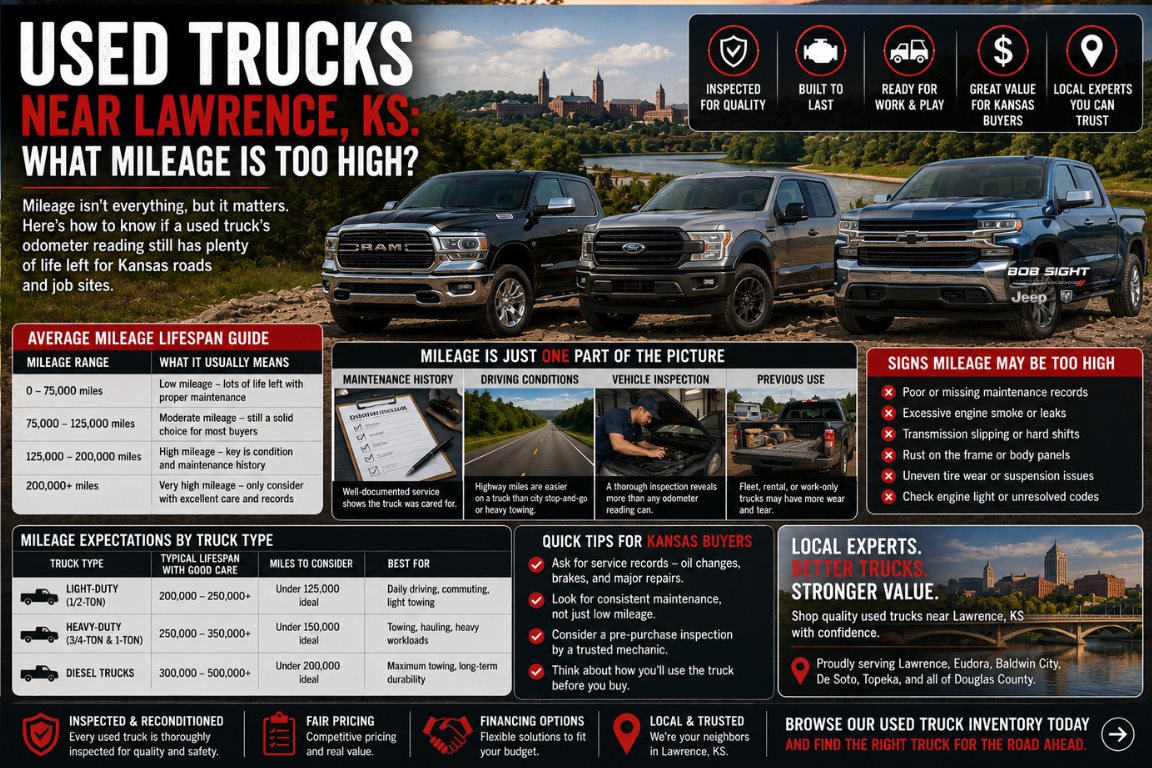
Determining what mileage is too high when shopping for used trucks near Lawrence, KS requires evaluating engine type, maintenance history, chassis condition, and intended usage rather than focusing on the odometer reading alone. Whether you need a dependable work truck for hauling construction materials along Highway 10, a light-duty pickup for daily commutes across Douglas County, or a heavy-duty diesel for towing heavy equipment trailers on Interstate 70 between Lawrence and Topeka, modern engineering allows pre-owned trucks to perform reliably far past traditional mileage milestones. At Bob Sight CDJR in Lawrence, Kansas, our sales and service specialists help local truck buyers evaluate pre-owned Ram 1500, 2500, and 3500 pickups so you can select a high-value truck that aligns with your operational goals and budget.
Shopping for a pre-owned truck in eastern Kansas presents distinct environmental factors that impact long-term vehicle health. Local trucks face harsh winter road salt along Interstate 35 toward Kansas City, muddy agricultural access routes near the Wakarusa River, and persistent highway crosswinds that test chassis integrity. Evaluating gas versus diesel engine longevity, inspecting underbody frame rails, reviewing vehicle history reports, and understanding preventive maintenance schedules allows local buyers to choose a pre-owned truck that delivers years of dependable daily service. Exploring key mileage thresholds, inspection guidelines, commercial utility factors, and ownership costs demonstrates why a properly maintained pre-owned truck remains an outstanding investment for Kansas drivers.
In This Guide You'll Learn
Here is what Kansas buyers will discover when evaluating mileage on pre-owned work and personal trucks:
- How modern engine manufacturing, advanced metallurgy, and synthetic lubricants extended expected truck lifespans far beyond 100,000 miles.
- Detailed breakdown of mileage ranges: under 50,000 miles, 50,000 to 100,000 miles, 100,000 to 150,000 miles, and 150,000+ miles.
- Key differences in high-mileage expectations between gasoline engines (Pentastar V6 and HEMI V8) and heavy-duty diesel engines (Cummins Turbo Diesel).
- A detailed comparison table analyzing gas vs diesel engine lifespans, maintenance priorities, and value thresholds.
- Critical mechanical components to inspect on high-mileage trucks, including suspension linkages, frame rust, transfer cases, and cooling systems.
- A comprehensive multi-point pre-purchase checklist specifically designed for evaluating pre-owned trucks in Northeast Kansas.
- Analysis comparing commercial fleet truck longevity against single-owner personal work trucks.
- Step-by-step guidance on evaluating CARFAX vehicle history reports, service records, and highway versus idle engine hours.
- Step-by-step financial advice on calculating commercial trade-in values, auto loan financing, Section 179 tax savings, and out-the-door pricing.
- Long-term preventive maintenance routines to preserve high-mileage engine reliability across changing Midwest driving conditions.
- Answers to frequently asked questions regarding high-mileage truck reliability, Certified Pre-Owned warranties, and resale value.
Understanding Mileage Thresholds: What Do the Numbers Really Mean?
Understanding how mileage thresholds correlate with vehicle condition, remaining mechanical lifespan, and price depreciation allows buyers to find the ideal balance between cost and long-term reliability. Buyers often fear the 100,000-mile mark, but modern pickups equipped with durable powertrains routinely cross 200,000 miles when serviced with regular oil changes and proper fluid upkeep.
1. Under 50,000 Miles: Low-Mileage and Near-New Performance
Pre-owned trucks with under 50,000 miles offer near-new vehicle condition with minimal mechanical wear. Original factory components, including brake pads, suspension bushings, and tires, are often still intact or recently replaced with original equipment manufacturer parts. These trucks are ideal for drivers seeking active manufacturer warranty coverage, modern cabin tech, and maximum remaining lifespan for daily commuting along K-10 or I-70. While they command a higher purchase price, they experience slower ongoing depreciation compared to brand-new vehicles.
2. 50,000 to 100,000 Miles: The Value Sweet Spot
The 50,000 to 100,000-mile range represents the sweet spot for many pre-owned truck buyers. The previous owner absorbed the steepest initial vehicle depreciation, offering significant purchase savings while the powertrain remains in its mechanical prime. A pre-owned Ram 1500 powered by the 3.6-liter Pentastar V6 or 5.7-liter HEMI V8 in this bracket easily provides another decade of dependable driving when properly maintained. Buyers should verify documented service records for spark plug replacements, transmission fluid flushes, and differential service.
3. 100,000 to 150,000 Miles: High-Value Practicality
Crossing 100,000 miles no longer signifies the end of a truck's useful life. Modern full-size trucks built over the last decade feature advanced metallurgy and precise engine tolerances that comfortably handle six-figure mileage. However, wear items such as shock absorbers, ball joints, water pumps, and alternator bearings may require replacement around this milestone. In Kansas, inspecting the undercarriage for surface rust caused by winter road salt and unpaved mud routes is essential when shopping in this mileage tier.
4. 150,000+ Miles: When Is Mileage Too High?
For gasoline-powered trucks, 150,000 miles requires careful mechanical evaluation. While many gas trucks reach 200,000 or 250,000 miles, ongoing maintenance costs for suspension overhauls and sensor replacements increase. However, for heavy-duty diesel pickups like a pre-owned Ram 2500 or 3500 with the 6.7-liter Cummins Turbo Diesel, 150,000 miles is often considered mid-life. A diesel engine with 150,000 to 200,000 miles that received regular fuel filter changes and synthetic oil service still offers immense towing capability for commercial fleets and agricultural operators.
Gas vs Diesel Engine Mileage: Key Longevity Differences
Gasoline and diesel engines handle mileage very differently due to their internal design, compression ratios, and fuel combustion characteristics. Comparing engine types side-by-side helps buyers determine whether a high-mileage gas or high-mileage diesel truck fits their driving needs.
Gasoline engines feature lighter internal components and operate at higher revolutions per minute, making them nimble and efficient for light towing and daily commuting. Modern gas engines like the 3.6-liter Pentastar V6 or 5.7-liter HEMI V8 routinely achieve 200,000 miles with strict maintenance. Heavy-duty diesel engines, by contrast, utilize cast-iron engine blocks, forged steel pistons, and high-compression combustion designed for heavy commercial stress. Because diesel engines operate at much lower RPMs and utilize diesel fuel, which possesses natural lubricating properties, internal engine wear accumulates far slower per mile driven.
The comparison table below outlines key operational differences between gas and diesel trucks across mileage brackets:
| Feature / Threshold | Gasoline Trucks (e.g., Ram 1500) | Heavy-Duty Diesel Trucks (e.g., Ram 2500/3500) |
|---|---|---|
| "High Mileage" Benchmark | 120,000 to 150,000 Miles | 200,000 to 250,000 Miles |
| Expected Total Engine Lifespan | 200,000 to 250,000+ Miles | 350,000 to 500,000+ Miles |
| Key Maintenance Focus | Spark plugs, ignition coils, cooling system, oil changes | Fuel filters, DEF system, turbocharger, EGR valve |
| Best Used Application | Daily driving, light contractor work, recreation | Heavy equipment towing, commercial fleets, long hauls |
What Factors Matter More Than the Odometer Reading?
Prioritizing vehicle maintenance records, driving conditions, and underbody structural integrity over odometer numbers ensures you buy a reliable pre-owned truck. A well-cared-for truck with 120,000 highway miles is often a far better purchase than a 70,000-mile truck that suffered from neglected oil changes and heavy job site idling.
Key factors to evaluate when shopping for a used truck include:
- Documented Maintenance History: Consistent synthetic oil changes every 5,000 to 7,500 miles preserve valvetrain components and precision bearings. Complete service records confirm that differentials, transfer cases, and transmissions received fresh lubricants on schedule.
- Highway Miles vs Idle Engine Hours: Trucks driven primarily at highway speeds between Lawrence, Topeka, and Kansas City experience continuous oil pressure and minimal engine thermal cycling. Conversely, commercial work trucks left idling for hours on construction sites accumulate engine wear that is not reflected on the odometer.
- Frame and Undercarriage Condition: Inspect frame rails, crossmembers, transfer case skid plates, and suspension leaf springs for structural rust or cracks. Winter road salt used on K-10 and I-70 can cause corrosion if the vehicle underbody was not washed regularly.
- Single-Owner vs Multi-Fleet Usage: Single-owner trucks often receive better interior care and prompt mechanical service compared to multi-driver fleet vehicles subjected to hard daily job site wear.
Comprehensive Pre-Purchase Inspection Checklist for Used Trucks
Using a standardized inspection checklist when evaluating a pre-owned truck prevents costly mechanical surprises and identifies upcoming maintenance needs. Performing these checks during your initial test drive ensures the vehicle meets safety and dependability standards.
Inspect the following key systems during your pre-owned truck evaluation:
- Engine Bay and Fluid Quality: Check engine oil clarity and dipstick level. Inspect transmission fluid (if dipstick equipped) for burnt odor or dark discoloration. Verify radiator coolant is clear and free of oil residue or rust scale.
- Cold Engine Start and Exhaust Inspection: Start the engine while cold. Listen for top-end valvetrain noise, manifold exhaust leaks, or abnormal belt squeal. Observe exhaust tailpipes for excessive blue smoke (indicating burnt oil) or white smoke (indicating coolant leaks).
- 4x4 Transfer Case and Drivetrain Function: Engage 4WD High and 4WD Low while rolling slowly on loose gravel or unpaved dirt. Confirm smooth actuator engagement without grinding, pop-out, or binding during low-speed turns.
- Steering and Suspension Tightness: Turn the steering wheel back and forth while stationary to check for excessive play or clunking in steering tie rods and ball joints. Push down on front bumpers to test shock absorber dampening.
- Brake Rotor Condition and Pad Thickness: Look through wheel spokes to inspect brake rotor surface smoothness. Ensure brake pads have at least 50 percent material remaining and verify the brake pedal feels firm under hard stopping.
- Underbody Frame Rails and Crossmember Integrity: Scrutinize frame rails near rear leaf spring mounts and fuel tank straps for deep flaking rust or structural cracks caused by road salt and mud buildup.
Commercial Fleet vs Personal Work Truck Longevity in Douglas County
Understanding how previous usage profiles impact vehicle wear helps buyers evaluate high-mileage work trucks accurately. Fleet trucks and privately owned trucks often show vast differences in maintenance rigor, cabin condition, and drivetrain stress.
Commercial fleet vehicles are frequently maintained on strict calendar schedules, receiving timely oil changes and safety inspections. However, fleet drivers may not treat interior upholstery or transmission shifting with the same care as an owner-operator. Privately owned personal work trucks often boast cleaner cabin trim and fewer idle engine hours, but maintenance records may be spotty if performed at home.
The comparison table below contrasts typical characteristics of pre-owned fleet trucks versus privately owned personal pickups:
| Vehicle Profile | Service History Profile | Cabin & Body Condition | Idle Hours & Stress Factors |
|---|---|---|---|
| Commercial Fleet Pickup | Strict fleet maintenance schedules; fully documented oil changes and safety checks. | Basic vinyl interiors; minor bed dents and scratches from job site tool loading. | Higher engine idle hours; frequent stop-and-go driving with heavy payload weights. |
| Privately Owned Pickup | Varies by owner; may range from dealer service logs to informal owner receipts. | Upgraded cloth or leather trim; cleaner paint finish and well-kept interior panels. | Lower idle hours; higher proportion of open highway driving between regional cities. |
Step-by-Step Guide: How to Inspect a High-Mileage Used Truck Before Purchase
Following a systematic inspection routine allows buyers to uncover hidden mechanical wear, suspension fatigue, and underbody corrosion before committing to a pre-owned truck. Conducting a thorough hands-on evaluation protects your financial investment and ensures long-term operational reliability.
Follow these five step-by-step procedures when inspecting a used truck at Bob Sight CDJR:
- Review CARFAX Vehicle History and Service Logs: Verify the number of previous owners, title status, accident history, and service locations. Confirm consistent oil changes, brake services, and safety inspections.
- Perform an Underbody Frame and Suspension Inspection: Examine the frame rails, crossmembers, fuel tank straps, and cab mounts using a flashlight. Check for deep scaling rust, frame welds, or bent suspension control arms.
- Check Engine Fluid Levels and Oil Clarity: Pull the engine oil dipstick to check for proper oil level and clarity. Inspect the radiator coolant reservoir for clean fluid free of oil contamination or rust scale.
- Test 4x4 Transfer Case Engagement on Low-Traction Surfaces: Engage 4WD High and 4WD Low modes on an unpaved gravel area to verify smooth mechanical engagement without grinding, clicking, or binding noises.
- Conduct a Comprehensive Road Test Across Speeds: Drive the truck along Iowa Street and onto K-10 highway speeds. Listen for wheel bearing hum, test brake pedal firmness during hard stops, and verify smooth transmission upshifts and downshifts.
Step-by-Step Guide: Commercial Financing, Trade Valuations, and Out-The-Door Costs
Structuring your pre-owned truck purchase involves evaluating trade-in equity allowances, business line-of-credit options, Section 179 tax savings, and itemized out-the-door pricing quotes. Establishing a clear financial budget ensures your monthly vehicle payments remain predictable and manageable.
Follow these five financial evaluation steps when purchasing a pre-owned truck at Bob Sight CDJR:
- Value Your Current Trade-In Vehicle Equity: Plain-language definition: Trade-in value represents the net monetary credit offered for your current vehicle, applying directly as a down payment toward your next purchase to reduce overall loan principal.
- Request an Itemized Out-The-Door Price Quote: Plain-language definition: Out-the-door pricing represents the complete final purchase cost including vehicle sale price, state sales taxes, local Douglas County title fees, and documentation charges with zero hidden fees.
- Explore Financing Options and Certified Pre-Owned Programs: Work with our finance department to evaluate competitive auto loan rates through Chrysler Capital or local Kansas credit unions, exploring Certified Pre-Owned warranty coverage for added peace of mind.
- Evaluate Section 179 Business Tax Deductions: Consult your business accountant regarding Section 179 tax guidelines, which allow qualified business owners to deduct the purchase price of eligible heavy-duty work trucks during the tax year placed in service.
- Factor in Annual Operating and Maintenance Expenses: Obtain an insurance quote and factor in routine oil changes, tire upkeep, and fuel costs to establish your total monthly operating budget.
Quick Facts: High-Mileage Used Trucks in Kansas
- Modern Engine Lifespan: Modern gasoline truck engines routinely reach 200,000+ miles, while heavy-duty diesel engines can exceed 350,000+ miles with proper maintenance.
- Certified Pre-Owned Assurance: CPO Ram trucks undergo a rigorous 125-point safety inspection and include a 7-Year/100,000-Mile Powertrain Limited Warranty.
- Maintenance Over Mileage: A 110,000-mile truck with documented synthetic oil service is often a safer purchase than an 80,000-mile truck with no service records.
- Kansas Undercarriage Care: Inspecting frame rails for winter salt corrosion is crucial when evaluating pre-owned trucks in Douglas and Shawnee counties.
- Standard 4x8 Cargo Fitment: All full-size Ram truck beds provide 51.0 inches of width between wheel wells, allowing standard building sheets to lie flat across the bed floor.
Ownership Planning: Maintenance Strategy for High-Mileage Pickups
Maintaining long-term reliability on a high-mileage pickup requires establishing a strict preventive maintenance routine using factory-certified fluids and technicians. Operating a pre-owned truck across changing Midwest seasons subjects engines, transmissions, and 4x4 transfer cases to continuous stress, making proactive service essential.
Engine oil care is vital for high-mileage gas and diesel powertrains. Utilizing recommended high-mileage synthetic oil formulations conditions internal engine seals, prevents oil burn-off, and protects precision valvetrain components during heavy towing along I-70 or K-10. Changing synthetic oil and rotating tires every 5,000 miles ensures uniform tire wear, preserves suspension alignment, and optimizes fuel economy.
Drivetrain and brake upkeep is equally essential for high-mileage trucks hauling heavy equipment or traversing unpaved rural roads. Inspecting front and rear differential gear oils, transfer case lubricants, and brake pad thickness prevents fluid oxidation and guarantees maximum stopping power. Utilizing genuine Mopar replacement parts and factory-certified fluids preserves complete mechanical compatibility. Our service center at Bob Sight CDJR provides fast Express Lane maintenance to keep your pre-owned truck on the road.
Frequently Asked Questions About Used Truck Mileage in Kansas
Is 100,000 miles considered too high for a pre-owned Ram 1500?
No, 100,000 miles is not considered too high for a pre-owned Ram 1500, provided the vehicle possesses a documented history of regular synthetic oil changes and routine maintenance. Both the 3.6-liter Pentastar V6 and 5.7-liter HEMI V8 engines are engineered for long-term durability, routinely reaching 200,000 miles or more without major mechanical overhauls. At 100,000 miles, buyers benefit from lower purchase prices while still enjoying years of reliable service for commuting, towing, and family recreation across Kansas.
Pro-Tip from the Bob Sight CDJR Service Bay: When buying a Ram 1500 with around 100,000 miles, inspect spark plug replacement records and test the serpentine belt and cooling hoses to ensure routine wear items are up to date.
What is the benefit of buying a Certified Pre-Owned (CPO) truck over a standard used truck?
Buying a Certified Pre-Owned (CPO) Ram truck provides factory-backed warranty protection, a thorough 125-point safety inspection, and complete CARFAX vehicle history transparency. CPO vehicles include a 7-Year/100,000-Mile Powertrain Limited Warranty and a 3-Month/3,000-Mile Maximum Care Coverage policy, protecting you against unexpected repair costs. Additionally, CPO buyers receive 24/7 Roadside Assistance, ensuring fast support if a flat tire or battery issue occurs on the road.
Pro-Tip from the Bob Sight CDJR Service Bay: CPO trucks must meet strict age and mileage limits (typically under 75,000 miles), making them an ideal choice for buyers seeking low-mileage peace of mind with factory warranty backing.
How many miles can a Cummins diesel engine last in a pre-owned Ram 2500 or 3500?
A 6.7-liter Cummins Turbo Diesel engine in a Ram heavy-duty truck can easily last between 350,000 and 500,000 miles when serviced with regular oil changes and fuel filter replacements. The cast-iron block and inline-six architecture are designed for heavy commercial durability. A diesel truck with 150,000 miles is often considered mid-life, offering tremendous towing value for contractors, farmers, and long-distance haulers across Midwest routes.
Pro-Tip from the Bob Sight CDJR Service Bay: Always replace both the primary and secondary fuel filters on Cummins diesel engines every 15,000 miles to protect high-pressure fuel injectors from fuel contamination.
What undercarriage components are most vulnerable to Kansas road salt and mud?
Frame rails near rear leaf spring shackles, fuel tank support straps, brake line fittings, and lower suspension control arm mounts are most vulnerable to road salt corrosion and mud retention. Winter road salt applied along Interstate 70 and Highway 10 mixes with wet mud from unpaved agricultural access roads, trapping moisture against metal components. Thoroughly washing the undercarriage after winter storms prevents severe surface scaling and preserves structural frame strength.
Pro-Tip from the Bob Sight CDJR Service Bay: Request an undercarriage lift inspection at Bob Sight CDJR before purchasing a pre-owned truck to verify frame rails and brake lines are rust-free.
How do idle hours affect engine wear on pre-owned commercial work trucks?
Heavy engine idling accumulates mechanical valvetrain wear and cylinder wall friction without registering miles on the dashboard odometer, making engine hour meters vital to check. As a general mechanical rule, 1 hour of engine idling equals roughly 25 to 30 miles of highway driving in terms of engine combustion wear and oil degradation. Reviewing total engine hours on the digital instrument cluster gives a complete picture of total engine usage.
Pro-Tip from the Bob Sight CDJR Service Bay: Check the digital vehicle info display on Ram trucks to compare drive hours versus idle hours before finalizing your pre-owned purchase.
Why Local Commercial and Personal Support Matters in Lawrence, KS
Purchasing and servicing your pre-owned truck at Bob Sight CDJR in Lawrence guarantees dedicated customer care, transparent pricing, and ongoing support from a family-owned local auto group. Conveniently located at 2300 W 29th Terrace in Lawrence, KS, our specialists understand local industry demands, helping contractors, farmers, and families find reliable trucks that match their driving needs.
Our commitment to local truck owners continues long after initial vehicle delivery. The Bob Sight CDJR service center features heavy-duty vehicle lifts, factory-certified technicians, and genuine Mopar OEM parts engineered for Chrysler, Dodge, Jeep, and Ram vehicles. Whether your truck requires routine synthetic oil changes, brake service, tire rotations, or complex 4x4 drivetrain repairs, our team delivers fast, reliable care that minimizes vehicle downtime.
We invite truck buyers across Douglas County, Topeka, Eudora, Baldwin City, and the KC Metro to explore our pre-owned Ram truck inventory online today. Test drive our reliable work and personal trucks, evaluate commercial financing options, and discover why generations of Kansas drivers trust Bob Sight CDJR for all their automotive needs.
Helpful Links
- Browse Pre-Owned Ram Truck Inventory in Lawrence, KS
- Shop Certified Pre-Owned Ram Trucks at Bob Sight CDJR
- Value Your Trade-In Vehicle Online at Bob Sight CDJR
- Schedule Certified Commercial Truck Service in Lawrence
- Apply for Commercial Financing Online at Bob Sight CDJR
Proud to be Part of the Bob Sight Auto Group
Bob Sight CDJR is proud to be part of the Bob Sight Auto Group, a family-owned network of automotive dealerships serving communities across Kansas and Missouri for generations. Built on a foundation of integrity, transparent pricing, exceptional vehicle selection, and dedicated customer service, our auto group takes pride in supporting local drivers throughout the region. Learn more about our full dealership network below: