Ram 1500 Fuel Economy Tips for Kansas Truck Owners
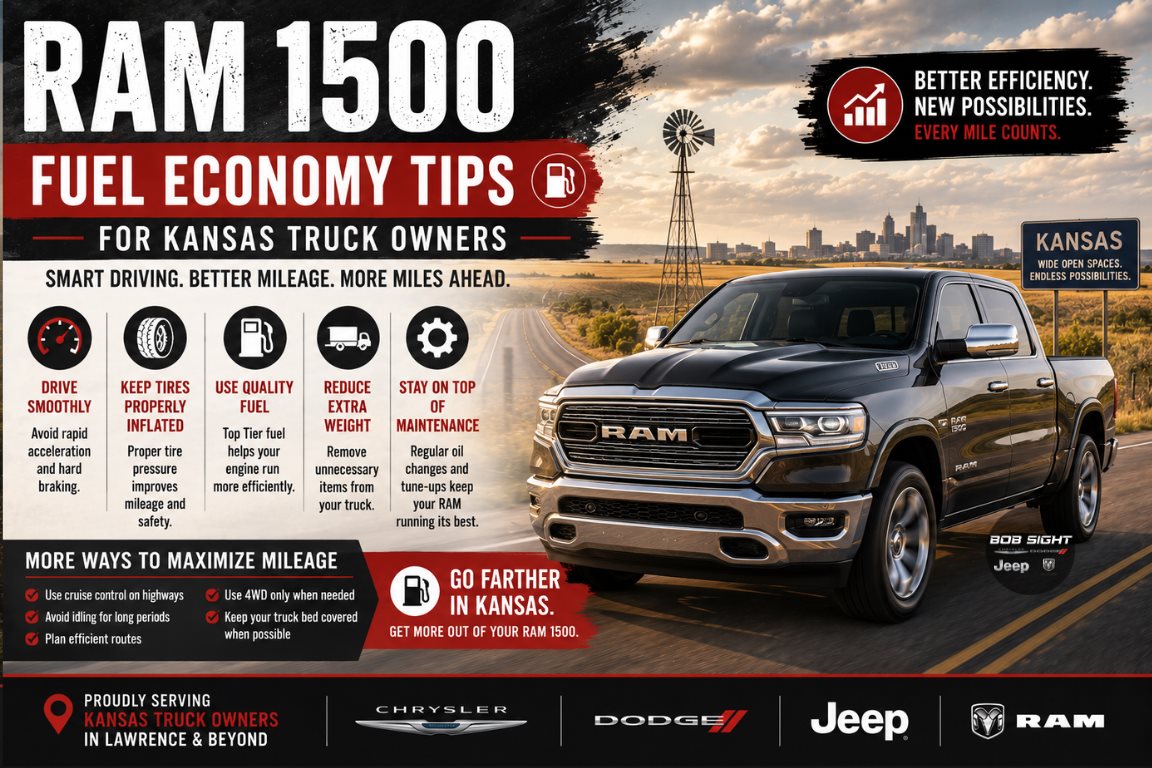
Maximize Your Highway Efficiency: Browse New Ram 1500 Inventory at Bob Sight CDJR in Lawrence, KS
Optimizing Ram 1500 fuel economy across Kansas requires a smart blend of proactive vehicle maintenance, engine specification awareness, aerodynamic management, and location-aware driving habits. Daily commuters driving along Highway 10 between Lawrence and Overland Park, contractors hauling gear across Douglas County, and families embarking on weekend trips down Interstate 70 toward Topeka all face unique road conditions that directly impact miles per gallon. At Bob Sight CDJR, located right here in Lawrence, Kansas, our service and sales specialists help truck owners unlock maximum efficiency from their full-size pickups without sacrificing towing capability or everyday utility. Whether your Ram 1500 features the standard 3.6-liter Pentastar V6 with eTorque, the high-output 3.0-liter Hurricane twin-turbo inline-six, or a classic 5.7-liter HEMI V8, implementing strategic fuel-saving measures keeps your trip costs low and your truck performing at its peak.
Driving across the central plains presents distinct environmental factors that influence truck fuel consumption. Open highway crosswinds, drastic seasonal temperature swings between blistering Midwest summers and freezing winter blasts, fluctuating tire pressures, and heavy urban stop-and-go driving along Iowa Street all affect your fuel economy. By understanding how your transmission shift points, tire tread resistance, active aerodynamics, and axle ratios operate together, you can adopt driving habits that save substantial money at the pump throughout the year. Exploring factory technology features alongside simple daily driving modifications allows Kansas truck owners to achieve exceptional fuel efficiency during every commute.
In This Guide You'll Learn
Here are the key fuel economy insights and truck maintenance strategies covered in this comprehensive guide:
- How different Ram 1500 powertrains deliver distinct fuel efficiency profiles across city and highway driving.
- How active aerodynamics, air dams, and air suspension lowering reduce drag at high speeds.
- Step-by-step tire pressure and chassis maintenance routines designed to preserve optimal fuel mileage.
- Plain-language explanations of axle ratios, payload weight, and their direct impact on fuel consumption.
- How to utilize Eco mode, adaptive cruise control, and TorqueFlite eight-speed transmission tuning for maximum MPG.
- Step-by-step driving habits to reduce fuel waste during urban commuting and heavy traffic.
- How seasonal Midwest weather shifts impact fuel blends, idle times, and winter mileage expectations.
- Answers to frequently asked questions regarding Ram 1500 fuel requirements, towing efficiency, and maintenance.
Understanding Ram 1500 Powertrains and Engine Efficiency in Kansas
The Ram 1500 offers diverse powertrain choices engineered to balance horsepower, towing capability, and overall fuel economy across city and highway driving. Matching your daily mileage requirements with the proper engine architecture ensures you enjoy strong performance without paying for unnecessary fuel consumption. From mild-hybrid electrical assistance to twin-turbocharged inline-six efficiency, each powertrain utilizes advanced engineering to extract maximum energy from every gallon of fuel.
The baseline 3.6-liter Pentastar V6 engine featuring 48-volt eTorque mild-hybrid technology represents the efficiency leader for daily commuting around Lawrence. Producing 305 horsepower and 269 lb-ft of torque, this engine utilizes an electric motor-generator to provide supplementary torque during initial acceleration and seamless stop-start functionality at red lights on Mass Street. In two-wheel drive configurations, the 3.6-liter Pentastar V6 achieves an EPA-estimated 20 MPG city and 26 MPG highway, making it the highest-rated standard gasoline engine in its class for long-distance highway travel.
For truck owners requiring substantial towing power alongside impressive highway fuel mileage, the 3.0-liter Hurricane twin-turbo inline-six engine delivers 420 horsepower and 469 lb-ft of torque. Replacing traditional large-displacement V8 engines, the Hurricane I6 utilizes direct fuel injection, variable valve timing, and twin low-inertia turbochargers to deliver immediate pulling power while achieving up to 18 MPG city and 25 MPG highway on two-wheel drive models. For ultimate performance, the High-Output 3.0-liter Hurricane I6 generates 540 horsepower and 521 lb-ft of torque while achieving up to 21 MPG highway in 4x4 configurations.
Legacy models and select trims featuring the 5.7-liter HEMI V8 engine with eTorque mild-hybrid technology rely on Fuel Saver Technology multi-displacement cylinder deactivation. When cruising at steady highway speeds along Interstate 70, the engine control module automatically seamlessly deactivates four of the eight cylinders to conserve fuel, reactivating all eight cylinders instantly when acceleration is needed. Knowing which powertrain resides under your hood allows you to tailor your driving habits to take full advantage of its specific fuel-saving technologies.
How Aerodynamics and Speed Impact Truck Fuel Economy on Kansas Highways
Aerodynamic drag increases exponentially as vehicle speed rises, making high-speed highway driving one of the primary drivers of reduced truck fuel economy across open Kansas corridors. Full-size pickup trucks present a large frontal surface area that encounters heavy air resistance when traveling along flat, open highways like K-10 and I-35. Managing your cruising speed and allowing factory active aerodynamic systems to function properly significantly reduces wind resistance and boosts miles per gallon.
Modern Ram 1500 trucks incorporate sophisticated active aerodynamic features engineered to optimize airflow automatically as speeds increase. An active front air dam deploys downward by 2.5 inches when the vehicle reaches 35 miles per hour, directing incoming air around the front tires and beneath the smooth underbody panels rather than turbulence-inducing suspension components. Furthermore, active grille shutters positioned behind the front grille automatically close at highway speeds when engine cooling demands are low, streamlining the front fascia and reducing aerodynamic drag by up to nine percent.
Trucks equipped with the available Active-Level Four-Corner Air Suspension system feature an automatic Aero Mode that activates at highway speeds. When traveling above 62 miles per hour, the system lowers the truck ride height by 0.6 inches. This subtle suspension drop lowers the vehicle center of gravity, reduces airflow beneath the chassis, and improves high-speed aerodynamic stability. Driving at steady speeds between 65 and 70 miles per hour rather than pushing past 75 miles per hour along the Kansas Turnpike prevents excessive aerodynamic drag from draining your fuel tank prematurely.
Adding aftermarket accessories can also alter your truck aerodynamic footprint and reduce fuel mileage. Tall suspension lift kits, wide off-road tires that project past wheel wells, bug deflectors, and open truck beds with exposed gear create drag that forces your engine to burn additional fuel. Utilizing a flush-mounted tonneau cover over your truck bed helps smooth air transition over the tailgate, yielding a measurable improvement in overall highway fuel efficiency during long cross-state trips.
Step-by-Step Tire and Chassis Maintenance Routine for Peak MPG
Maintaining correct tire pressure, proper wheel alignment, and clean chassis components is essential for minimizing rolling resistance and maximizing Ram 1500 fuel economy. Underinflated tires increase the contact patch between the tire rubber and the road surface, causing excessive drag that forces the engine to burn extra fuel to maintain momentum. Implementing a disciplined monthly maintenance routine safeguards your tires against uneven wear while ensuring your truck rolls down the highway with minimal mechanical resistance.
Follow these five step-by-step maintenance procedures to keep your Ram 1500 running at peak fuel efficiency:
- Check Cold Tire Pressures Monthly: Use a high-quality digital tire pressure gauge to measure inflation pressures first thing in the morning before driving. Ensure all four tires match the cold PSI specification listed on the driver door jamb placard, typically between 35 and 38 PSI for light-duty truck tires.
- Perform Regular Wheel Alignments: Schedule a four-wheel alignment inspection every 10,000 to 12,000 miles or whenever you notice steering wheel pull or uneven tire tread wear. Proper toe, camber, and caster angles prevent tires from scrubbing against the asphalt, which directly restores lost fuel economy.
- Inspect and Replace Engine Air Filters: Check your engine air filter every 7,500 miles, especially after driving through dusty unpaved gravel roads around Clinton State Park or rural Douglas County. A clean air filter allows the intake manifold to draw unrestricted airflow, maintaining the optimal air-fuel ratio required for efficient combustion.
- Change Engine Oil with Recommended Viscosity: Utilize factory-recommended synthetic engine oil formulations, such as 0W-20 for the 3.6L Pentastar V6 or 5W-30 / 0W-40 for specialized Hurricane turbo engines. Correct oil viscosity reduces internal mechanical friction within cylinder walls and valvetrain components, optimizing fuel mileage.
- Clean Underbody and Active Air Dam Components: Thoroughly wash mud, road grime, and winter road salt away from the active front air dam, steering linkages, and brake calipers. Ensuring moving aerodynamic components move freely without mechanical binding guarantees active airflow systems deploy correctly on the highway.
By completing these maintenance steps regularly at home or scheduling routine service at Bob Sight CDJR in Lawrence, KS, you eliminate preventable energy losses. Small maintenance details combine to produce noticeable gains in fuel efficiency, saving you money at every fill-up while extending component lifespans.
Defining Axle Ratios and Payload Weight: Plain-Language Tech Breakdown
An axle ratio represents the relationship between the rotational speed of the driveshaft and the rotational speed of the rear axle gears, directly governing the balance between pulling power and engine RPM. Expressed as a numerical ratio such as 3.21:1, 3.55:1, or 3.92:1, the number indicates how many times the driveshaft turns for every single rotation of the rear wheels. Understanding how axle ratios and carried payload weight impact engine effort allows truck buyers and owners to make informed choices for their fuel economy goals.
A lower numerical axle ratio like 3.21:1 is commonly called a tall axle ratio. In a truck equipped with a 3.21:1 rear gear, the engine operates at lower revolutions per minute (RPM) while cruising at 70 miles per hour on Highway 10. Lower engine RPM translates directly into reduced fuel consumption during unladen highway commuting, making 3.21 gears the ideal choice for drivers prioritizing long-distance fuel economy. However, tall axle ratios offer slightly lower maximum trailer towing ratings compared to aggressive gear sets.
Conversely, a higher numerical axle ratio like 3.92:1 is known as a short or aggressive axle ratio. A 3.92:1 gear set turns the driveshaft 3.92 times for every wheel revolution, providing greater mechanical leverage for accelerating heavy trailers or hauling dense payloads up steep incline grades near the Wakarusa River. While 3.92 gears deliver impressive low-end pulling muscle and maximum tow ratings up to 11,550 pounds on Hurricane-powered models, they cause the engine to run at higher RPM during highway cruising, slightly reducing overall highway fuel efficiency.
Payload weight represents the combined weight of all passengers, cargo in the cab, tools in the truck bed, and tongue weight exerted by a trailer. Carrying unneeded weight, such as heavy sandbags left in the truck bed during dry summer months or unnecessary construction materials, forces the engine to burn extra fuel during every acceleration cycle. Clearing unnecessary cargo out of your truck cab and bed reduces curb weight, allowing your Ram 1500 to operate closer to its peak factory EPA fuel economy ratings.
Comparing Driving Modes and Transmission Calibration: Eco Mode vs Tow/Haul
Selecting the appropriate driving mode recalibrates transmission shift schedules, throttle response curves, and cylinder deactivation behavior to match your immediate driving environment. Modern Ram 1500 pickups utilize electronic throttle control and the TorqueFlite eight-speed automatic transmission to optimize power delivery. Understanding when to engage Eco mode versus Tow/Haul mode prevents engine lugging and eliminates unnecessary fuel consumption when operating under varying loads.
The table below compares key operational parameters between standard driving, Eco mode, and Tow/Haul mode on Ram 1500 trucks:
| Drive Mode | Throttle Response | Transmission Shift Strategy | Air Suspension Height | Primary Driving Purpose |
|---|---|---|---|---|
| Normal Mode | Balanced Linear Mapping | Standard Up-Shifts for Comfort | Standard Ride Height (Aero at Speed) | Everyday Commuting & Unladen Driving |
| Eco Mode | Relaxed / Reduced Sensitivity | Early Up-Shifts / Low Engine RPM | Lowers to Aero Height Sooner | Maximum Highway Fuel Efficiency |
| Tow / Haul Mode | Aggressive / Immediate Response | Delayed Up-Shifts / Down-Shift Braking | Locks Out Aero Lowering | Pulling Heavy Trailers & Heavy Cargo |
Engaging Eco mode adjusts throttle sensitivity so that aggressive pedal inputs are smoothed out, preventing sudden fuel enrichment spikes. The eight-speed transmission shifts into higher gear ratios earlier during acceleration runs, keeping engine speeds in the low-RPM sweet spot where fuel usage is minimal. On trucks equipped with air suspension, Eco mode triggers Aero mode lowering at lower speed thresholds, optimizing aerodynamic drag during suburban cruising along Kasold Drive.
Conversely, Tow/Haul mode is specifically engineered to protect drivetrain components when pulling heavy trailers down I-35 or hauling construction equipment across Shawnee County. Tow/Haul mode holds lower gears longer to maintain engine power within peak torque curves and engages aggressive transmission downshifting during braking to provide engine braking relief. While Tow/Haul mode increases engine RPM and fuel consumption during towing operations, using it prevents gear hunting, reduces transmission fluid operating temperatures, and ensures vehicle control under heavy loads.
Step-by-Step Driving Techniques to Maximize Miles Per Gallon in Traffic
Modifying daily driving behavior is the most immediate and cost-effective method to increase truck fuel economy during suburban commuting and city traffic. Aggressive acceleration, hard braking, and excessive idling consume large quantities of fuel without saving meaningful travel time. Adopting smooth driver inputs and anticipating traffic flow transforms your Ram 1500 into an efficient daily commuter across Lawrence and the greater Kansas City metro area.
Follow these five step-by-step driving techniques to maximize fuel mileage during daily travel:
- Accelerate Smoothly and Progressively: Apply gentle, steady pressure to the accelerator pedal when pulling away from stoplights on Iowa Street. Aim to take five seconds to accelerate up to 15 miles per hour, allowing the TorqueFlite eight-speed transmission to shift smoothly through lower gears without revving engine speeds high.
- Anticipate Traffic Signals and Coast Early: Look ahead at traffic flow and upcoming traffic lights along 23rd Street. When you see a red light ahead, lift your foot off the accelerator pedal early and allow engine braking to coast the truck forward, reducing momentum gradually without burning unnecessary fuel.
- Utilize Adaptive Cruise Control on Highways: Engage Adaptive Cruise Control with Stop and Go when driving along open stretches of K-10 or I-70. The automated system maintains precise throttle modulation and consistent cruising speeds far more efficiently than manual foot adjustments, eliminating micro-accelerations that waste gas.
- Minimize Prolonged Engine Idling: Turn off your engine if you are parked waiting for family members or stopped at train crossings near downtown Lawrence for longer than 60 seconds. A idling full-size truck engine burns up to half a gallon of fuel per hour without moving an inch.
- Maintain Safe Following Distances: Leave a three-to-four-second cushion between your front bumper and preceding vehicles. Adequate spacing allows you to absorb minor speed fluctuations in highway traffic without constantly tapping your brakes and re-accelerating.
Integrating these simple driving adjustments into your daily routine yields significant cumulative fuel savings over thousands of annual miles. Driving smoothly not only reduces trips to the gas station but also minimizes brake pad wear and tire tread erosion, lowering your overall cost of vehicle ownership.
Seasonal Fuel Mileage Strategies for Midwest Winters and Summers
Midwest climate extremes in Kansas impact truck fuel efficiency through seasonal fuel formulation blends, thermal engine management, and climate control loads. Both freezing winter temperatures and scorching summer heat present unique challenges that force your engine and electrical systems to work harder. Understanding how weather shifts affect fuel economy helps truck owners set realistic mileage expectations and adopt proper seasonal maintenance habits.
During cold Kansas winters, gasoline suppliers transition to winter-blend fuel, which contains higher Reid Vapor Pressure (RVP) additives like butane to facilitate reliable engine ignition in sub-zero temperatures. Winter-blend gasoline contains slightly less energy per gallon than summer-blend fuel, resulting in an inherent two to five percent reduction in overall fuel economy. Furthermore, cold engine oil, thick differential gear lubricants, longer warm-up idling times, and winter tire rolling resistance further lower fuel mileage during morning commutes across Douglas County.
To combat winter efficiency losses, avoid prolonged remote engine warm-ups lasting longer than three to five minutes. Modern fuel-injected Ram 1500 engines warm up significantly faster and burn less fuel when driven gently under light load rather than idling stationary in a driveway. Keeping your truck parked inside a home garage overnight shields the engine block and battery from extreme frost, allowing engine fluids to reach operating temperatures faster upon startup.
In contrast, summer fuel economy is primarily impacted by heavy air conditioning compressor usage and high ambient temperatures. Running the climate control system on maximum refrigeration places continuous parasitic mechanical drag on the engine serpentine belt system, reducing fuel efficiency by up to 10 percent in slow-speed city traffic. Utilizing window sunshades when parked, lowering windows briefly to purge heat before turning on AC, and utilizing the climate control Recirculation mode reduces compressor workload while keeping cabin temperatures cool during summer road trips across eastern Kansas.
Quick Facts: Ram 1500 Fuel Economy Highlights
- Top Gas Highway Efficiency: The 3.6L Pentastar V6 with eTorque achieves up to 20 MPG city and 26 MPG highway on 4x2 models, leading standard gasoline full-size trucks.
- Twin-Turbo Inline-Six Mileage: The 3.0L Hurricane I6 produces 420 horsepower while achieving up to 18 MPG city and 25 MPG highway on 4x2 configurations.
- Active Aerodynamic Systems: Automatic front air dams deploy at 35 MPH and active grille shutters close at speed to reduce aerodynamic drag by up to 9 percent.
- Air Suspension Aero Lowering: Active-Level Air Suspension lowers truck ride height by 0.6 inches at highway speeds to streamline airflow underneath the chassis.
- Fuel Tank Cruising Range: Equipped with the optional 33-gallon fuel tank, a Ram 1500 can achieve a total highway cruising range exceeding 700 miles on a single fill-up.
These key specifications illustrate how advanced engineering allows modern Ram trucks to balance muscular capability with impressive real-world efficiency. Visiting Bob Sight CDJR in Lawrence allows you to explore these features in person, test drive different powertrain options, and discover how easy it is to optimize your truck fuel economy.
Long-Term Ownership Planning and Scheduled Preventive Maintenance
Protecting long-term fuel efficiency and mechanical dependability requires adhering to factory scheduled maintenance intervals using genuine Mopar parts and fluids. A full-size truck represents a significant financial investment, and maintaining precision engine components prevents performance degradation as miles accumulate. Establishing a regular maintenance plan with certified technicians keeps your Ram 1500 operating with the same fuel economy and smooth power delivery as the day it left the showroom floor.
Engine spark plugs, oxygen sensors, and fuel injectors play crucial roles in maintaining complete fuel combustion. Over extended mileage, worn spark plug electrodes produce weaker ignition sparks, causing incomplete fuel burn and wasted fuel down the exhaust system. Replacing spark plugs at factory-recommended intervals (typically 96,000 to 100,000 miles on modern V6 and Hurricane engines) guarantees precise ignition timing and restores lost engine efficiency. Additionally, scheduling periodic fuel system cleaning services removes carbon deposits from intake valves and injector nozzles, ensuring fine fuel atomization for optimal mileage.
Drivetrain fluid maintenance is equally vital for trucks that haul heavy cargo or navigate challenging weather in Kansas and Missouri. Servicing front and rear differential gear oils, transfer case fluids, and automatic transmission fluid prevents fluid breakdown and reduces internal friction across precision gears. Utilizing genuine Mopar synthetic gear lubricants engineered specifically for Ram axles protects internal bearings and maintains low rolling resistance. Partnering with the dedicated service center at Bob Sight CDJR guarantees your truck receives factory-certified care from technicians who know every system inside and out.
Frequently Asked Questions About Ram 1500 Fuel Economy in Kansas
What is the most fuel-efficient engine available in the Ram 1500?
The most fuel-efficient gasoline engine in the Ram 1500 lineup is the 3.6-liter Pentastar V6 with 48-volt eTorque mild-hybrid technology, which delivers up to 20 MPG city and 26 MPG highway on two-wheel drive models. This reliable engine utilizes variable valve timing, two-step variable valve lift, and an electric motor-generator that provides seamless engine stop-start functionality at red lights and smooth low-speed torque delivery. For drivers seeking maximum highway fuel economy during daily commutes between Lawrence and Topeka without needing extreme heavy towing limits, the 3.6L Pentastar V6 is the ideal choice.
For truck owners who require higher towing capacities alongside strong fuel efficiency, the 3.0-liter Hurricane twin-turbo inline-six engine achieves up to 18 MPG city and 25 MPG highway on 4x2 models while generating an impressive 420 horsepower. The Hurricane engine replaces traditional V8 options by utilizing twin turbochargers and direct injection to deliver muscular pulling strength when needed while maintaining excellent cruising efficiency on the highway.
Pro-Tip from the Bob Sight CDJR Service Bay: Check your tire pressures every month when cold to ensure you achieve your truck maximum rated EPA fuel economy. Underinflated tires increase rolling resistance and can lower your real-world fuel economy by up to two miles per gallon during highway driving along K-10.
Does using high-octane premium gasoline improve fuel mileage in a Ram 1500?
Using premium 91-octane gasoline is required for peak horsepower and fuel efficiency on models equipped with the 3.0-liter Hurricane twin-turbo inline-six engines, but regular 87-octane fuel is fully sufficient for the standard 3.6-liter Pentastar V6. Turbocharged engines operate under high intake cylinder pressures, where higher-octane fuel prevents engine knock and allows the engine control unit to advance ignition timing for maximum efficiency. While the standard-output Hurricane engine can run on 87-octane unleaded during light driving, using recommended 91-octane fuel optimizes fuel economy and power delivery when towing heavy loads across Kansas.
For Ram 1500 trucks equipped with the standard 3.6L Pentastar V6 engine, paying extra for premium 91 or 93-octane gasoline does not provide measurable improvements in fuel economy or horsepower. The Pentastar engine compression ratio and ignition mapping are specifically calibrated for regular 87-octane unleaded gasoline, making regular unleaded the most cost-effective choice at the pump.
Pro-Tip from the Bob Sight CDJR Service Bay: When towing heavy trailers during hot summer months across Douglas County, filling your Hurricane-powered Ram 1500 with premium 91-octane gasoline prevents thermal knock retards. Premium fuel keeps your engine operating at maximum thermal efficiency under heavy engine loads and high ambient temperatures.
How much does towing a trailer lower my Ram 1500 fuel economy?
Towing a heavy trailer typically reduces full-size truck fuel economy by 30 to 50 percent depending on trailer weight, frontal surface area, axle ratio, and towing speed. Pulling a large camper rig, enclosed box trailer, or heavy boat creates substantial mechanical weight resistance and aerodynamic drag that forces the engine to operate under continuous high load. While an unladen Ram 1500 might achieve 22 to 25 MPG on the highway, pulling an 8,000-pound travel trailer along Interstate 70 usually results in fuel economy ranging between 10 and 14 MPG.
Drivers can minimize towing fuel penalties by maintaining steady towing speeds between 60 and 65 miles per hour rather than pushing past 70 MPH. Higher speeds dramatically increase wind resistance against the trailer front wall, forcing the transmission to hold lower gears and burn excessive fuel. Ensuring trailer tires are properly inflated and using a weight-distributing hitch also reduces pulling resistance and stabilizes vehicle tracking.
Missouri and Kansas Highway Driving Alert: When hauling heavy loads along hilly highway sections near the Ozark foothills or rural Kansas routes, engage Tow/Haul mode on your TorqueFlite eight-speed transmission. Tow/Haul mode prevents rapid gear shifting, keeps engine temperatures cool, and maintains efficient power delivery without straining your drivetrain.
Can adding a tonneau cover to my truck bed really improve fuel mileage?
Yes, installing a smooth, flush-mounted tonneau cover over an open truck bed can improve highway fuel economy by approximately one to two percent by reducing aerodynamic air turbulence over the tailgate. An open truck bed allows high-speed air flowing over the cab to swirl inside the bed cavity, creating a low-pressure air pocket that exerts rearward aerodynamic drag against the tailgate. A closed tonneau cover creates a flat surface that allows air to transition smoothly off the rear of the vehicle, reducing drag during long highway drives along K-10 and I-35.
While a tonneau cover provides a modest fuel economy benefit, its primary advantages are secure weatherproof cargo storage and protection against interior bed rust and scratch damage. Hard folding or soft roll-up tonneau covers from genuine Mopar accessory lines provide perfect fitment and clean aerodynamic profiles tailored specifically to your Ram 1500 bed length.
Pro-Tip from the Bob Sight CDJR Service Bay: Avoid driving with your tailgate lowered in an attempt to improve fuel economy. Testing shows that lowering the tailgate alters factory airflow design and actually increases aerodynamic drag compared to driving with a closed tailgate or a quality tonneau cover.
How does winter-blend gasoline affect my truck fuel economy in eastern Kansas?
Winter-blend gasoline contains volatile additives like butane that lower the energy content per gallon, resulting in an automatic two to five percent decrease in overall fuel mileage during cold months. Fuel refiners alter gasoline chemical blends in late autumn across Kansas and Missouri to ensure engines start easily in freezing weather. Because butane has a lower energy density than standard summer gasoline components, your engine must burn slightly more fuel to produce the same amount of power during winter driving.
Combined with longer engine warm-up idling, cold transmission gear oil, low winter tire pressures, and dense cold air resistance, winter fuel mileage drops are completely normal for all vehicles. Truck owners can offset these seasonal losses by minimizing unnecessary remote idling, storing their truck in a garage when available, and checking tire inflation regularly during freezing weather snaps.
Kansas Seasonal Maintenance Alert: Cold winter temperatures cause tire pressures to drop by roughly one PSI for every ten-degree drop in outside air temperature. Check your tire inflation weekly during severe winter spells in Douglas County to prevent underinflated tires from compounding winter fuel economy losses.
Why Local Service and Guidance at Bob Sight CDJR Matters for Kansas Drivers
Servicing your Ram 1500 at Bob Sight CDJR in Lawrence guarantees expert care from factory-certified technicians who understand the unique driving conditions across Kansas and Missouri. Our local dealership team is committed to providing transparent service, authentic Mopar replacement parts, and dedicated customer support tailored to full-size truck owners. Whether you need routine synthetic oil changes, wheel alignments, tire replacements, or comprehensive multi-point vehicle inspections, we ensure your truck remains efficient, powerful, and reliable for years to come.
Building a relationship with a trusted local dealership provides access to specialized diagnostic tools and factory recalibration software specifically designed for Chrysler, Dodge, Jeep, and Ram vehicles. From performing ECU software updates that optimize transmission shift logic to inspecting active aerodynamic air dam actuators, our service department delivers unmatched technical precision. Furthermore, our convenient online scheduling, Express Lane service bays, and comfortable customer lounges make routine maintenance effortless for busy working professionals and business operators.
We invite you to visit Bob Sight CDJR in Lawrence, KS today to explore our full line of new and pre-owned Ram 1500 trucks for sale. Speak with our knowledgeable team, schedule a test drive, and discover how our dealership can help you maximize fuel efficiency, performance, and long-term value from your pickup truck.
Helpful Links
- Browse New Ram 1500 Truck Inventory in Lawrence, KS
- Schedule Ram Truck Service at Bob Sight CDJR
- Visit Bob Sight CDJR Express Lane for Quick Maintenance
- Value Your Trade-In at Bob Sight CDJR
- Order Genuine Mopar Ram Parts & Accessories
Proud to be Part of the Bob Sight Auto Group
Bob Sight CDJR is proud to be part of the Bob Sight Auto Group, a family-owned dealership network dedicated to serving communities across Kansas and Missouri with integrity, transparency, and top-tier service. Our automotive group brings decades of automotive expertise and community commitment to every customer relationship. Explore our full dealership family below: