Jeep Wrangler vs Toyota 4Runner for Outdoor Adventure Seekers in the Kansas City Metro
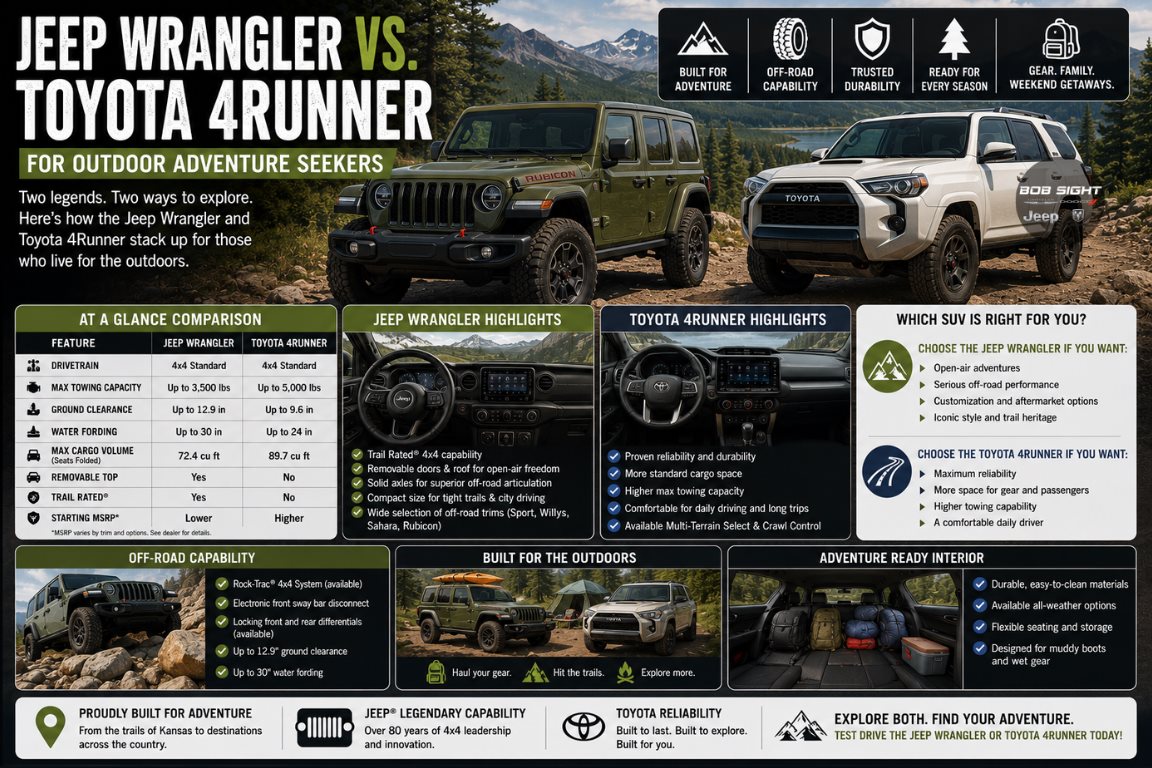
Explore New Jeep Wrangler Inventory at Bob Sight CDJR in Lawrence, KS
Choosing between the legendary Jeep Wrangler and the Toyota 4Runner for outdoor adventure across Kansas requires comparing removable open-air capabilities, heavy-duty solid axle architecture, and off-road trail geometry. At Bob Sight Chrysler Dodge Jeep Ram in Lawrence, Kansas, we frequently guide outdoor enthusiasts from Topeka, Eudora, Baldwin City, and across Douglas County who demand an authentic 4x4 capable of tackling muddy weekend trails and unpredictable Midwest seasonal roads. Whether you are hauling camping gear to Clinton Lake State Park, exploring unpaved backroads near Perry Lake, or navigating heavy winter snow squalls along Interstate 70, having the right all-terrain vehicle makes every excursion safer and more thrilling. This comprehensive comparison breakdown details the off-road hardware, powertrain performance, open-air customization, and daily driving comfort of the Jeep Wrangler versus the Toyota 4Runner to help you select the ultimate adventure machine.
In This Guide You'll Learn:
Discover how the trail-rated Jeep Wrangler compares against the Toyota 4Runner for off-road excursions and daily driving across Northeast Kansas.
- Why the Jeep Wrangler front and rear solid Dana 44 axles deliver superior articulation over independent front suspension setups on rugged trails.
- The open-air freedom advantages of removable doors, fold-down windshields, and soft or hard top roof options exclusive to the Wrangler.
- Approach, departure, and breakover angle comparisons that give the Wrangler decisive advantage over rocks, ruts, and steep inclines near Clinton Lake.
- Engine powertrain choices including the standard 3.6L Pentastar V6, torque-rich 2.0L Turbo, 4xe Plug-In Hybrid, and 470-hp Rubicon 392 V8.
- A step-by-step evaluation guide for test driving and inspecting off-road 4x4 vehicles in Lawrence, KS.
- Essential off-road preparation and maintenance procedures for keeping your 4x4 drivetrain operating reliably after muddy trail rides.
- A detailed technical specification matrix comparing 4x4 transfer cases, axle lockouts, ground clearances, and trail equipment.
Why Outdoor Adventure Seekers Compare the Jeep Wrangler vs Toyota 4Runner
Comparing the Jeep Wrangler and Toyota 4Runner pits the world's most recognizable convertible 4x4 against a conventional enclosed body-on-frame SUV. Outdoor adventurers throughout Shawnee County, Johnson County, and Douglas County regularly cross-shop these two off-road icons because both hold an enduring reputation for durability and off-pavement utility. However, stepping inside and driving both models immediately reveals fundamental architectural differences. The Jeep Wrangler is engineered from the ground up as a modular, purpose-built trail vehicle with removable doors and flexible roof configurations that connect passengers directly with the natural environment.
The Jeep Wrangler appeals directly to drivers who view their vehicle as an essential piece of outdoor equipment rather than mere transportation. Navigating tight forest trails near Perry Lake or climbing muddy embankments requires precise wheel placement and maximum suspension travel. The Wrangler utilizes heavy-duty Dana solid front and rear axles that keep all four tires planted firmly on uneven terrain, maximizing traction where independent suspension systems lift tires off the ground. Furthermore, the short wheelbase and tight turning radius of the Wrangler make maneuvering through densely wooded paths or crowded parking spots along Iowa Street in Lawrence effortless.
On the other hand, the Toyota 4Runner offers a traditional, fully enclosed cabin design utilizing an independent front suspension layout. While the 4Runner delivers steady highway tracking during routine commutes along Highway K-10, its fixed steel roof, non-removable doors, and longer front overhang limit total off-road freedom and geometry. For true outdoor enthusiasts who crave open-air driving on sunny summer afternoons near Clinton Lake, the fixed cabin of the 4Runner simply cannot replicate the immersive sensation provided by a Jeep Wrangler.
Off-Road Geometry, Articulation, and Solid Axle Engineering Explained
The Jeep Wrangler features superior approach, departure, and breakover angles combined with solid Dana 44 axles that deliver unmatched suspension articulation on extreme off-road trails. Off-road capability is defined by physical geometry long before horsepower enters the equation. On a Trail-Rated Wrangler Rubicon, the approach angle reaches an impressive 47.4 degrees, allowing you to climb steep ledges without scraping the front bumper. Coupled with up to 12.9 inches of ground clearance and water fording capability up to 34 inches, the Wrangler drives through deep creek crossings and washed-out gravel trails across Northeast Kansas with complete authority.
A crucial technical advantage of the Wrangler is its front electronical sway bar disconnect system, known as the Tru-Lok system. At the touch of a dashboard button, the front anti-roll bar disengages automatically, allowing the front axle to articulate independently over massive obstacles. This mechanical freedom allows the front wheels to droop deep into ruts and maintain ground contact, ensuring continuous drive torque transmission. In contrast, the Toyota 4Runner utilizes an independent front suspension setup that restricts front wheel articulation, increasing the likelihood of wheel spin and frame scraping on severe trail inclines.
To further understand off-road mechanical terms, let us define suspension articulation and crawl ratio in plain language for prospective buyers. Suspension articulation refers to the total vertical distance a tire can move relative to the vehicle frame while maintaining tire contact with the ground. Crawl ratio is the total gear reduction mathematical product of the transmission first gear, transfer case low-range gear, and differential axle ratio. The Wrangler Rubicon achieves an astonishing 100:1 crawl ratio, allowing the vehicle to creep up steep, rocky inclines at sub-walking speeds without stalling the engine or slipping the tires.
Powertrain Versatility: Pentastar V6, Turbo, 4xe Plug-In Hybrid, and V8 Muscle
The Jeep Wrangler provides four distinct powertrain choices, outclassing the single engine availability of the Toyota 4Runner across output, efficiency, and electric capability. Under the hood of the standard Wrangler sits the legendary 3.6-liter Pentastar V6 generating 285 horsepower and 260 lb-ft of torque, available with a smooth 6-speed manual transmission or an ultra-responsive 8-speed automatic. Buyers seeking low-end throttle response can select the 2.0-liter turbocharged inline four-cylinder engine delivering 270 horsepower and 295 lb-ft of torque, providing rapid boost build-up for merging onto I-70 or pulling through heavy sand.
For eco-conscious outdoor adventurers, the innovative Jeep Wrangler 4xe Plug-In Hybrid pairs a 2.0-liter turbocharged engine with high-torque electric motors to produce an incredible 375 horsepower and 470 lb-ft of instant torque. The 4xe allows drivers to travel up to 21 miles on pure electric power alone, enabling completely silent off-road rock crawling through nature reserves without exhaust noise or emissions. When traveling long distances across state lines toward Colorado or the Ozarks, the hybrid system seamlessly transitions to hybrid gas-electric mode, eliminating range anxiety completely while maintaining impressive fuel economy.
At the absolute summit of off-road performance is the unstoppable Wrangler Rubicon 392, powered by a massive 6.4-liter HEMI V8 producing 470 horsepower and 470 lb-ft of torque. Accelerating from 0 to 60 mph in just 4.5 seconds, the Rubicon 392 combines sports car acceleration with heavy-duty beadlock-capable wheels and factory dual-mode exhaust. The Toyota 4Runner, by contrast, historically offered an aging 4.0-liter V6 and now transitions to a turbocharged four-cylinder setup, lacking any V8 performance option or true plug-in hybrid electric driving mode.
Open-Air Modular Freedom vs Enclosed Conventional SUV Cabins
Exclusive open-air features like removable doors, fold-down windshields, and multiple quick-release roof choices give the Jeep Wrangler an unmatched sensory connection to the outdoors. Outdoor adventure is about experiencing nature firsthand, and no other production SUV allows you to strip away cabin barriers like the Wrangler. Jeep offers a variety of top configurations, including the easy-to-fold Sunrider soft top, the lightweight Freedom Top three-piece hardtop, and the revolutionary Sky One-Touch Power Top that slides open at the push of a button even while driving down 23rd Street at 45 mph.
Removing the lightweight aluminum doors on a Wrangler takes only minutes using the factory-supplied toolkit stowed neatly in the rear cargo floor. With the doors stored in your garage and the windshield folded flat onto the hood bumpers, driving down scenic country roads near Baldwin City or through Clinton State Park becomes an unforgettable open-air experience. The interior is designed to withstand exposure to dust and light rain, featuring weather-resistant carpet, rubberized switchgear, and integrated floor drain plugs that allow you to hose out dirt and mud after an intense weekend of trail riding.
The Toyota 4Runner offers a traditional fixed-roof SUV experience with standard roll-down door glass and an optional power sunroof. While functional for standard highway commutes, the 4Runner cabin remains completely enclosed, isolating occupants from the sights, smells, and breeze of the outdoor environment. For drivers who prioritize authentic outdoor lifestyle immersion during weekend camping trips or lake outings, the customizable modular freedom of the Wrangler provides a level of excitement that no traditional SUV can match.
Step-by-Step Guide: How to Evaluate a 4x4 Vehicle for Off-Road Trail Duty
Evaluating a 4x4 vehicle for serious off-road use requires testing transfer case engagement, underbody protection, suspension travel, and low-speed throttle modulation under realistic conditions. Taking a prospective 4x4 on a brief highway test drive is not enough to verify its true trail readiness. Following a structured inspection and drive routine at Bob Sight CDJR ensures you evaluate the exact mechanical features required for adventurous driving across Kansas terrain.
- Engage Low-Range 4x4 Transfer Case: Shift the transfer case lever into 4-Low (4L) while rolling slowly at 1-3 mph with the transmission in neutral. Verify smooth mechanical engagement and confirm that electronic stability control programs adjust automatically for low-speed torque delivery.
- Test Axle Lockers and Sway Bar Disconnect: On Rubicon models, press the axle locker switches to engage front and rear differential locks. Verify on the digital instrument cluster that both differentials lock completely, then test the electronic front sway bar disconnect to observe increased wheel suspension travel.
- Inspect Underbody Skid Plate Armor: Crawl beneath the vehicle to inspect factory steel skid plates protecting critical components. The Wrangler includes heavy-gauge steel shielding for the fuel tank, transfer case, and automatic transmission oil pan.
- Evaluate Turning Radius and Visibility: Perform tight full-lock turning circles in a spacious parking area to test overall maneuverability. Observe driver visibility over the hood line and check how easily you can view front tire placement relative to the road edge.
- Test Low-Speed Hill Descent Controls: Drive onto an incline and engage Select-Speed Control or Hill Descent Control. Verify that the vehicle automatically manages braking pressure and engine speed, allowing you to descend steep grades without touching the brake pedal.
Taking the time to conduct this thorough off-road inspection highlights the mechanical sophistication built into every Trail-Rated Jeep Wrangler. Our knowledgeable sales staff at Bob Sight CDJR is always ready to demonstrate these four-wheel-drive features in person during your test drive.
Step-by-Step Ownership Guide: Post-Trail Inspection and Drivetrain Maintenance
Preserving the long-term reliability of your 4x4 after rigorous off-road trail riding requires cleaning underbody components, inspecting differential seals, and checking air intake filters. Muddy trails near Clinton Lake and sandy creek beds place extra stress on mechanical components, steering joints, and fluid breathers. Following a consistent post-adventure maintenance sequence protects your drivetrain investment and ensures your Wrangler remains fully dependable for daily commuting along K-10 highway.
- Hose Down Underbody and Brake Assemblies: Pressure wash accumulated mud, clay, and road salt from skid plates, brake calipers, and suspension coil springs immediately after returning from trails. Removing caked mud prevents wheel imbalance and prevents trapped moisture from corroding chassis components.
- Inspect Differential Breather Hoses and Axle Seals: Check that flexible axle breather tubes remain securely attached to the axle housings above water line levels. Inspect differential pinion seals for signs of oil weeping after deep water crossings.
- Clean or Replace Engine Air Filtration Elements: Remove the engine air filter cover and tap out accumulated dust, sand, or trail debris. Replace the air filter element if dirty to maintain optimum engine airflow and fuel efficiency.
- Check Tire Pressures and Tread Inspection: Re-inflate tires back to recommended highway pressures using an onboard compressor or gas station pump after airing down for trail traction. Carefully inspect tire sidewalls for deep cuts, punctures, or embedded rocks.
- Verify Steering Linkage and Ball Joint Integrity: Inspect drag links, tie rods, and steering damper bushings for slop or play. Ensure grease fittings are lubricated during routine oil change intervals at Bob Sight CDJR.
Adhering to these simple post-trail steps guarantees that your Wrangler transitions seamlessly from weekend mud trail warrior to smooth, quiet Monday morning commuter. Our certified service technicians at Bob Sight CDJR stock genuine Mopar lubricants, heavy-duty filters, and performance accessories tailored specifically for Jeep 4x4 systems.
Comparison Table: Jeep Wrangler Rubicon vs Toyota 4Runner TRD Off-Road
A head-to-head factory specification comparison illustrates the decisive advantages the Jeep Wrangler Rubicon holds over the Toyota 4Runner TRD Off-Road in trail geometry and drivetrain options. While both vehicles represent top-tier off-road packages from their respective manufacturers, their technical specs highlight distinct engineering priorities. The table below outlines key dimensions, off-road equipment, and performance ratings to assist your decision:
| Specification / Feature | Jeep Wrangler Rubicon (4-Door) | Toyota 4Runner TRD Off-Road |
|---|---|---|
| Front Axle Architecture | Heavy-Duty Dana 44 Solid Axle | Independent Front Suspension (IFS) |
| Rear Axle Architecture | Heavy-Duty Dana 44 HD Full-Float Axle | Solid Rear Axle with Coil Springs |
| Approach Angle | 47.4 Degrees (Best-in-Class) | 32.0 Degrees |
| Departure Angle | 40.4 Degrees | 26.0 Degrees |
| Breakover Angle | 27.8 Degrees | 23.0 Degrees |
| Maximum Ground Clearance | Up to 12.9 Inches | 9.6 Inches |
| Front Sway Bar Disconnect | Electronic Hydraulic Disconnect (Standard) | Not Available (KDSS optional on select trims) |
| Differential Lockers | Front and Rear Tru-Lok Electronic Lockers | Rear Electronic Locker Only |
| Maximum Crawl Ratio | 100:1 Crawl Ratio (Manual) / 77.2:1 (Automatic) | Approximately 36:1 Crawl Ratio |
| Roof / Door Removability | Fully Removable Roof and Doors (Standard) | Non-Removable Fixed Roof and Doors |
For dedicated off-road enthusiasts who demand maximum trail geometry and front-and-rear differential locking power, the Jeep Wrangler Rubicon provides factory equipment that would cost thousands of dollars to replicate on a Toyota 4Runner through aftermarket modifications. It stands as the undisputed benchmark for factory off-road capability.
Quick Facts: Jeep Wrangler vs Toyota 4Runner Highlights
Here is a quick summary of key comparative facts and capability highlights between the Jeep Wrangler and Toyota 4Runner:
- Solid Axle Articulation: Wrangler features front and rear solid Dana 44 axles for superior wheel droop and ground contact on extreme rocky terrain.
- Unrivaled Trail Angles: Jeep Wrangler Rubicon delivers 47.4-degree approach and 40.4-degree departure angles, far exceeding the 4Runner angles.
- Plug-In Hybrid Efficiency: Wrangler 4xe offers 375 hp, 470 lb-ft of instant torque, and 21 miles of pure electric driving range with zero emissions.
- Modular Open-Air Design: Only the Wrangler features completely removable doors, fold-down windshield, and multiple quick-release soft and hard top roof choices.
- Heavy-Duty Towing & Recovery: Factory steel bumpers with integrated tow hooks, winch-ready steel plates, and up to 5,000-pound maximum towing capacity on select 4-door models.
- Advanced Uconnect Tech: Available 12.3-inch touchscreen display with integrated off-road trail maps, pitch-and-roll telemetry screens, and wireless Apple CarPlay.
These key highlights explain why outdoor adventure seekers across Northeast Kansas consistently select the Jeep Wrangler as their ultimate vehicle. It delivers a thrilling combination of authentic mechanical capability, modern cabin tech, and open-air freedom.
Ownership Planning for Long-Term Value and Midwest Off-Road Driving
Long-term ownership satisfaction with an adventure 4x4 requires selecting the ideal roof package, axle ratios, and protective accessories tailored to your long-term recreational goals. When purchasing a new or certified pre-owned Jeep Wrangler at Bob Sight CDJR, evaluating how you intend to use your vehicle over five to ten years helps ensure you choose the exact trim and factory options upfront. Drivers planning to install larger 35-inch or 37-inch all-terrain tires in the future benefit greatly from selecting models equipped with 4.56 or 4.88 factory axle gearing, saving significant re-gearing expenses later.
Midwest environmental conditions in Lawrence, Topeka, and surrounding counties present unique maintenance demands, ranging from humid summer heat to heavy winter road salt. Protecting your vehicle frame and body underbody with corrosion-inhibiting sprays and installing rubberized all-weather floor mats prevents moisture from damaging carpeted footwells. Routine underbody washdowns after driving through slushy winter brine along I-70 preserves frame rails and brake lines for decades of reliable service.
Partnering with Bob Sight CDJR for scheduled oil changes, tire rotations, differential fluid flushes, and Mopar accessory installations guarantees your Wrangler receives expert care from factory-certified technicians. Keeping complete maintenance records enhances vehicle reliability and supports strong resale value when you decide to trade in your vehicle down the road. Thoughtful ownership planning ensures every road trip and off-road expedition remains safe, enjoyable, and hassle-free.
Frequently Asked Questions About Jeep Wrangler vs Toyota 4Runner
Is the Jeep Wrangler better off-road than the Toyota 4Runner?
Yes, the Jeep Wrangler offers superior off-road capability thanks to its solid front and rear Dana 44 axles, front electronic sway bar disconnect, and significantly higher approach and departure angles. While the Toyota 4Runner is a capable body-on-frame SUV, its independent front suspension setup limits front wheel articulation over large obstacles. The Wrangler Rubicon includes both front and rear differential lockers as standard equipment, whereas the 4Runner TRD Off-Road only offers a rear differential locker.
Additionally, the Wrangler shorter wheelbase, tighter turning radius, and superior breakover angle allow it to navigate tight forest trails and steep rock ledges without scraping chassis skid plates or getting high-centered. The Wrangler also offers up to 12.9 inches of ground clearance from the factory, giving it a clear height advantage over the 4Runner 9.6 inches of ground clearance.
If your adventure plans include navigating muddy trails near Clinton Lake or tackling rocky terrain in regional off-road parks, the Wrangler provides factory off-road hardware that outmatches the 4Runner. Test drive a Trail-Rated Wrangler at Bob Sight CDJR to feel the off-road stability firsthand.
Can you remove the doors and roof on a Toyota 4Runner like a Jeep Wrangler?
No, the Toyota 4Runner features a fixed steel body shell with non-removable doors and a conventional welded steel roof structure. The Jeep Wrangler is the only production SUV in this class designed specifically with a modular body structure that allows doors to be removed in minutes and tops to be folded back or removed entirely. Jeep provides a dedicated Torx tool kit with every Wrangler to make door removal fast and straightforward.
The Wrangler also features a fold-down windshield that folds flat onto the hood, giving drivers an unobstructed 360-degree open-air driving experience. Interior components, including weather-resistant bucket seats and rubberized switchgear, are engineered to handle sun exposure and dust buildup during doorless driving sessions around Douglas County.
For drivers who desire true open-air freedom during warm Kansas spring and summer months, the Wrangler stands completely unrivaled. Visit Bob Sight CDJR in Lawrence to see how simple it is to operate Wrangler soft tops, hardtops, and removable door hinges.
How do the daily commuting driving dynamics compare between the Wrangler and 4Runner?
The Toyota 4Runner offers a traditional, slightly softer SUV ride quality on smooth pavement, but recent Jeep Wrangler JL models feature refined five-link coil suspensions and acoustic insulation that deliver exceptional daily highway comfort. Older generations of off-road vehicles were known for rough highway rides, but the modern Jeep Wrangler JL platform combines precise electro-hydraulic steering with tuned shock dampening to manage highway speeds along I-70 and K-10 smoothly.
Inside the Wrangler cabin, available features like heated leather seats, a heated steering wheel, dual-zone automatic climate control, and a 12.3-inch Uconnect touchscreen bring luxury-level comfort to daily commutes. Acoustic laminated glass and active noise cancellation technology reduce wind noise significantly, even when equipped with aggressive all-terrain tires.
Choosing between the two often comes down to personal driving preference during daily commutes past KU campus or running errands along Iowa Street in Lawrence. Schedule a comprehensive road test at Bob Sight CDJR to experience how quiet and comfortable the modern Wrangler performs on city streets and highways.
What are the fuel economy and hybrid options for the Jeep Wrangler vs Toyota 4Runner?
The Jeep Wrangler offers the 4xe Plug-In Hybrid powertrain delivering 49 MPGe and 21 miles of pure electric range, providing efficiency options unavailable on conventional 4Runner models. The Wrangler 4xe combines a 2.0L turbocharged engine with electric motor generators, allowing owners to complete daily short commutes around Lawrence or Topeka using electricity alone without burning a drop of gasoline.
Gasoline-powered Wrangler models equipped with the 2.0L Turbo or 3.6L Pentastar V6 achieve competitive fuel economy ratings paired with a sophisticated 8-speed automatic transmission. The Toyota 4Runner has historically suffered from lower fuel economy ratings due to its heavy curb weight and four-speed or five-speed automatic transmissions, making the Wrangler 4xe a far more versatile choice for fuel-conscious buyers.
Exploring the Wrangler 4xe hybrid powertrain at Bob Sight CDJR allows you to calculate potential fuel savings while enjoying 470 lb-ft of instant electric torque. Our team can guide you through home charging options and state tax incentive details.
Why Choose Bob Sight CDJR for Your Jeep Wrangler Adventure SUV
Bob Sight CDJR in Lawrence, Kansas, is your premier destination for the full lineup of Trail-Rated Jeep Wrangler models backed by transparent pricing and personalized customer service. Serving adventure drivers across Lawrence, Topeka, Eudora, Baldwin City, and the entire Kansas City metro, our dealership is dedicated to matching your specific off-road goals with the ideal vehicle package. Located conveniently near K-10 highway and US Route 59, our modern showroom features an extensive inventory of new 2-door and 4-door Wrangler models, including Sport, Willys, Sahara, Rubicon, and 4xe hybrid trims.
Our commitment to your adventure journey continues long after you drive off our lot. Our state-of-the-art CDJR service center is staffed by factory-certified technicians who specialize in 4x4 maintenance, wheel alignments, lift kit installations, and genuine Mopar accessory mounting. From routine synthetic oil changes and tire rotations to installing heavy-duty winches and rock rails, we provide complete service support to keep your 4x4 performing at its peak across Kansas trails. We offer easy online scheduling, express service lanes, and comfortable customer lounges for your convenience.
When you are ready to experience the open-air freedom, solid-axle capability, and iconic style of the Jeep Wrangler, visit Bob Sight CDJR on 23rd Street in Lawrence. Explore our online inventory, schedule your off-road test drive, and take advantage of competitive trade-in valuations and financing programs tailored to your budget.
Helpful Links
- New Jeep Wrangler Inventory
- New Jeep Gladiator Inventory
- Schedule a Test Drive Online
- Value Your Trade-In
- Schedule Service at Bob Sight CDJR
Proud to Be Part of the Bob Sight Auto Group
Bob Sight CDJR is proud to serve Midwest drivers as a key dealership within the trusted Bob Sight Auto Group family. For generations, the Bob Sight Auto Group has provided honest automotive advice, quality vehicle inventory, and dedicated customer care across Kansas and Missouri. Whether you need a Trail-Rated Jeep SUV, a reliable Honda sedan, a versatile Kia crossover, a rugged Ford truck, or certified body shop repairs, our dealership network is here to exceed your expectations.