Jeep Wrangler Trail Features Explained for New Off-Road Drivers
Ready to Hit the Kansas Trails? Browse New Jeep Wrangler Inventory at Bob Sight CDJR in Lawrence, KS
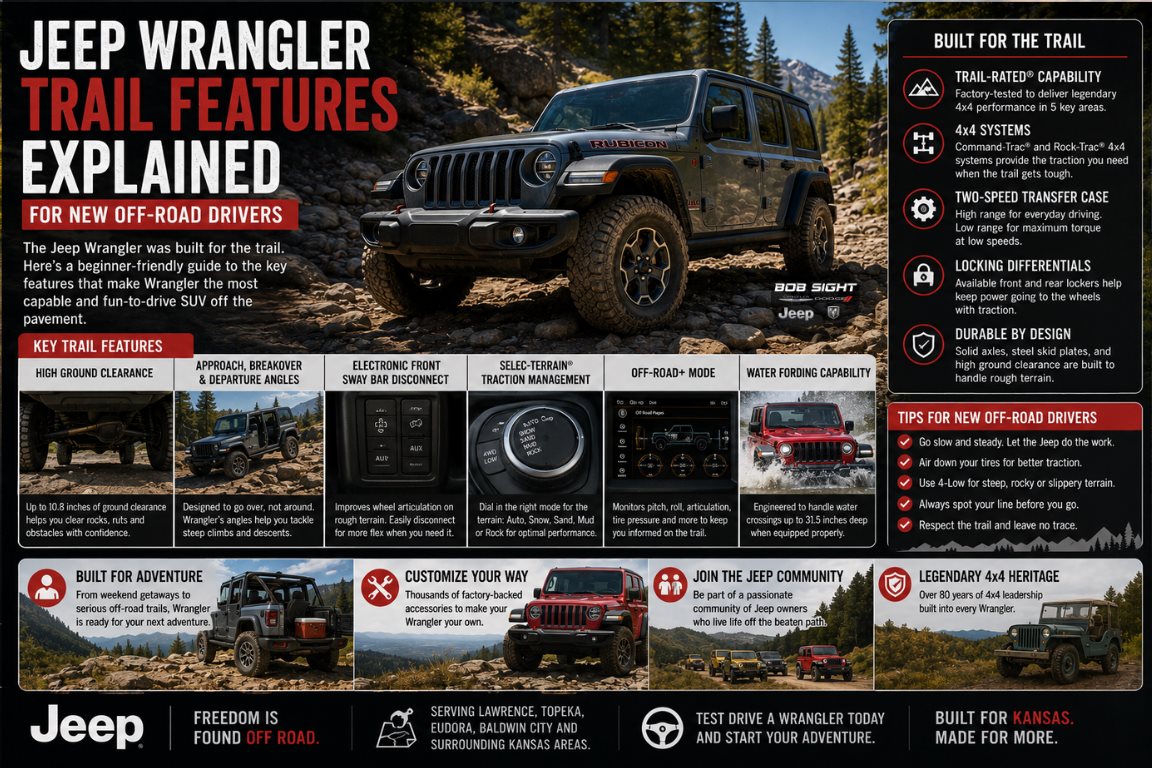
Understanding the specialized 4x4 systems, electronic locking differentials, sway bar disconnects, transfer case gear ratios, and crawl ratios on a Jeep Wrangler empowers beginner off-road drivers to navigate Kansas trails with complete confidence and mechanical awareness. Whether you are planning your first trail ride through the mud access routes near the Wakarusa River, exploring unpaved agricultural backroads across rural Douglas County, traversing dirt trails near Clinton State Park, or taking a weekend trip down toward the Ozark foothills, the iconic Jeep Wrangler is engineered from the ground up to tackle rugged, unpredictable terrain. At Bob Sight CDJR in Lawrence, Kansas, our sales and service specialists are passionate about helping new Jeep owners decode the heavy-duty off-road hardware built into their vehicles so they can enjoy safe, exhilarating, and mechanically sound trail adventures.
Taking a brand-new 4x4 off the paved highway for the first time can feel intimidating if you are unfamiliar with transfer case levers, air-down tire pressures, low-range crawl ratios, or axle articulation principles. Modern Wranglers seamlessly blend legendary mechanical off-road components, such as solid Dana front and rear axles, heavy-duty steel skid plates, and mechanical locking differentials, with cutting-edge trail electronics, including forward-facing trail cameras, digital pitch-and-roll telemetry, and intuitive electronic traction management. Learning how each feature functions, when to engage specific 4WD modes, and how to perform proper pre-trail preparation and post-trail maintenance protects your vehicle investment while ensuring maximum capability across eastern Kansas landscapes.
In This Guide You'll Learn
Here is what new off-road drivers will discover in this comprehensive Jeep Wrangler trail guide:
- The rigorous engineering behind the Jeep Trail Rated badge and how Wranglers are tested across five distinct capability categories.
- How Command-Trac part-time, Selec-Trac full-time, and Rock-Trac heavy-duty 4x4 systems function across different surface conditions.
- When and how to properly engage 4H (4WD High), 4L (4WD Low), Tru-Lok electronic locking differentials, and front sway bar disconnects.
- Understanding key off-road clearance geometry: approach angles, breakover angles, departure angles, ground clearance, and water fording limits.
- A detailed comparison table analyzing off-road equipment specs across Wrangler Sport, Willys, Sahara, Rubicon, and Rubicon 392 trim levels.
- A step-by-step beginner guide to pre-trail inspection, airing down tires, choosing trail lines, and managing throttle control.
- Step-by-step guidance on evaluating trade-in equity, exploring finance pre-approvals, and securing transparent out-the-door pricing at Bob Sight CDJR.
- Comprehensive post-trail maintenance routines to clean underbody components, clear brake assemblies, and inspect differential breathers after off-road excursions.
- Answers to frequently asked questions regarding Wrangler trail driving, transfer case operation, tire pressure management, and factory warranty coverage.
Decoding the Jeep Trail Rated Badge: 5 Performance Standards Explained
Every Jeep Wrangler wears the hard-earned Trail Rated badge on its front fender, signifying that the vehicle model has passed grueling factory and real-world testing across five demanding off-road performance criteria: traction, water fording, maneuverability, articulation, and ground clearance. This badge is not a decorative trim emblem; it is a rigorous engineering validation confirming that your vehicle contains factory-installed underbody steel skid plates, heavy-duty solid front and rear axles, frame-mounted tow hooks, high-mounted air intakes, and sealed electrical systems capable of withstanding extreme trail conditions.
Understanding these five Trail Rated performance categories helps beginner drivers appreciate the structural capability built into every Wrangler configuration:
- Traction: Evaluates the 4x4 system's ability to maintain continuous forward momentum over slick river mud, loose gravel, deep winter snow, wet rocks, and steep unpaved inclines. Testing ensures engine torque is effectively transferred to wheels with grip.
- Water Fording: Tests electrical harness sealing, body seam weatherstripping, and elevated engine air intake placement. This allows stock Wranglers to cross streams, flooded trail paths, and standing water up to 34 inches deep at slow, controlled speeds without engine water ingestion.
- Maneuverability: Measures steering box responsiveness, turning radius metrics, and front/rear wheel track alignment to ensure drivers can navigate tight forest switchbacks, dense timber trails, and narrow boulder passages without getting wedged.
- Articulation: Evaluates total suspension travel and axle flexibility, ensuring that all four tires maintain firm physical contact with the ground when traversing uneven terrain, deep offset ruts, and large rocks, preserving maximum driving traction.
- Ground Clearance: Guarantees generous underbody clearance—ranging from 9.7 inches up to 12.9 inches on models equipped with the Xtreme 35 Package—protected by high-strength steel skid plates covering the fuel tank, transfer case, oil pan, and automatic transmission oil pan.
Jeep 4x4 Systems Deep Dive: Command-Trac, Selec-Trac, and Rock-Trac
Jeep equips the Wrangler lineup with three distinct four-wheel-drive transfer case systems tailored to different driving habits, regional weather needs, and trail demands: Command-Trac part-time 4x4, Selec-Trac full-time 4x4, and Rock-Trac heavy-duty 4x4. Knowing which transfer case system is installed in your Wrangler trim ensures correct driver operation and prevents unnecessary driveline wear.
1. Command-Trac Part-Time 4x4 System
Standard on Wrangler Sport, Sport S, and Willys trims, the Command-Trac Part-Time 4x4 System utilizes an NV241 manual shift-on-the-fly transfer case featuring a 2.72:1 low-range gear reduction ratio. Command-Trac operates in 2H (Two-Wheel Drive High) for normal highway driving on dry pavement. When shifted into 4H (Four-Wheel Drive High) or 4L (Four-Wheel Drive Low), the transfer case mechanically locks the front and rear driveshafts together, forcing front and rear axles to rotate at identical speeds. Because the driveshafts are locked, Command-Trac must only be used on loose, low-traction surfaces like mud, sand, snow, or dirt. Driving in 4H on dry, high-traction asphalt causes "driveline binding" (or wheel hop) during turns, which can damage transfer case gears and axle joints.
2. Selec-Trac Full-Time 4x4 System
Available on Sahara and select Rubicon models, the Selec-Trac Full-Time 4x4 System incorporates an internal center differential with an electronic clutch pack. In addition to standard 2H, 4H Part-Time, and 4L modes, Selec-Trac features a 4H AUTO setting. In 4H AUTO, the system continuously monitors wheel speed sensors, throttle position, and steering angles, sending torque to the rear wheels during normal driving and automatically routing engine power to the front wheels the instant rear slip is detected. This full-time capability makes Selec-Trac an exceptional choice for Kansas drivers dealing with unpredictable winter weather, patchy black ice, rainstorms, and mixed pavement along Highway 10, Interstate 70, and Iowa Street in Lawrence.
3. Rock-Trac Heavy-Duty 4x4 System
Built exclusively for Rubicon and Rubicon X trims, the Rock-Trac 4x4 System represents the peak of factory off-road transfer case engineering. Featuring a heavy-duty NV241OR transfer case with a 4:1 low-range gear reduction ratio, Rock-Trac quadruples engine torque delivered to the axles when shifted into 4L. Paired with Tru-Lok locking differentials and available low axle gear ratios (such as 4.10:1 or 4.56:1), Rock-Trac delivers an astonishing crawl ratio of up to 100:1 with a manual transmission or 77:1 with an automatic. This extreme gear reduction allows the Wrangler Rubicon to crawl over massive boulders, steep ledges, and deep mud at a slow, walk-along pace without requiring excessive throttle input or riding the brakes.
Essential Trail Hardware: Differentials, Sway Bars, and Off-Road Plus
Beyond the 4x4 transfer case, heavy-duty mechanical hardware including Tru-Lok electronic locking differentials, electronic front sway bar disconnects, Dana 44 heavy-duty axles, and Off-Road Plus mode provide absolute vehicle control on difficult trail obstacles. Understanding how and when to activate these mechanical features gives drivers total control when traction is severely compromised.
Under normal road conditions, standard "open" differentials allow left and right tires on the same axle to rotate at different speeds, which is necessary when making smooth turns on pavement. However, if one tire lifts into the air or lands in slick mud, an open differential naturally routes 100 percent of engine torque to the spinning tire with the least resistance, leaving the grounded tire stationary. Tru-Lok Electronic Locking Differentials (standard front and rear on Rubicon, rear-equipped on Willys) solve this problem. At the push of a dash switch, internal electromagnetic lockers mechanically lock the left and right axle shafts together. This forces both tires on the axle to spin at the exact same speed regardless of traction, driving the Wrangler forward even if one wheel is suspended in mid-air or stuck in deep grease-like Kansas clay.
The Electronic Front Sway Bar Disconnect system addresses suspension flexibility. While a rigid front sway bar reduces body roll during high-speed highway cornering, it limits front axle movement off-road. Pushing the "Sway Bar" button on the lower center console (operable in 4H or 4L at speeds under 18 mph) actuates a solenoid that disconnects the front sway bar links. Disconnecting the sway bar increases front axle articulation by up to 30 percent, allowing front wheels to drop deep into depressions or climb over high rocks while keeping all four tires firmly planted against the terrain to maintain maximum mechanical grip.
Additionally, Off-Road Plus Mode adapts electronic vehicle software to match terrain demands. Activated via a button on the dash, Off-Road Plus automatically adjusts throttle pedal sensitivity, transmission shift points, and electronic stability control thresholds. When activated in 4H, it optimizes vehicle dynamics for higher-speed sand dune and gravel trail driving; when engaged in 4L, it fine-tunes throttle progression for ultra-precise, low-speed rock crawling control.
Understanding Trail Clearance Geometry and Underbody Protection
Evaluating approach angles, breakover angles, departure angles, and ground clearance metrics prevents underbody frame scraping when driving over logs, steep ledge drops, or rocky embankments. Factory Jeep engineers optimize bumper shapes, axle positioning, and frame height to maximize off-road clearance while keeping the vehicle center of gravity stable.
The table below provides a clear breakdown of key off-road clearance geometry concepts every beginner trail driver should master:
| Trail Geometry Term | Plain-Language Definition | Why It Matters on the Trail |
|---|---|---|
| Approach Angle | The maximum angle of a steep incline or obstacle a vehicle can climb from level ground without the front bumper touching the terrain. | Allows front tires to make direct contact with steep rock ledges or riverbanks before the front bumper strikes (Up to 47.4° on 4-door Rubicon). |
| Breakover Angle | The maximum crest angle a vehicle can drive over without the middle of the underbody frame scraping or hanging up on the apex. | Prevents "high-centering" (getting stuck like a seesaw) when driving over fallen trees, sharp hill crests, or boulder ridges (Up to 32.4° on 2-door Rubicon). |
| Departure Angle | The maximum angle of a slope a vehicle can descend without the rear bumper or tow hitch dragging against the ground as tires level out. | Protects the rear bumper, exhaust tailpipe, and tow hitch receiver when dropping off steep ledges or exiting steep ravines (Up to 40.4°). |
| Ground Clearance | The total vertical distance between the lowest mechanical component (typically the differential housings) and the ground surface. | Allows the vehicle to clear rocks, tree stumps, and deep mud ruts without dragging underbody component bellies (Up to 12.9 inches with Xtreme 35 Package). |
| Water Fording Depth | The maximum depth of standing or moving water a stock vehicle can safely drive through at slow speeds without water entering the air intake. | Protects engine intake valves, alternator electronics, and cabin flooring when crossing stream beds or flooded trails (Up to 34 inches deep). |
Comparing Jeep Wrangler Trim Levels for Off-Road Capability
Comparing off-road hardware features across Jeep Wrangler trim levels helps buyers align their vehicle purchase with their intended off-road goals and daily highway commuting needs. From entry-level capability to extreme rock-crawling equipment, the Wrangler lineup offers tailored builds for every adventure level.
The comparison table below outlines key off-road hardware specifications across popular Jeep Wrangler trims available at Bob Sight CDJR:
| Wrangler Trim Tier | Standard 4x4 System | Axles & Differentials | Standard Tire Setup | Primary Off-Road Focus |
|---|---|---|---|---|
| Sport / Sport S | Command-Trac Part-Time 4x4 (2.72:1 Low) | Dana 30 Front / Dana 44 Rear (Open Diffs) | 31-inch All-Season Tires | Daily Commuting & Light Unpaved Trail Driving |
| Willys | Command-Trac Part-Time 4x4 (2.72:1 Low) | Heavy-Duty Dana 44 Front & Rear / Rear Electronic Locker | 33-inch All-Terrain Tires | Mud Trails, Unpaved Backroads & Rugged Capability |
| Sahara | Selec-Trac Full-Time 4x4 (2.72:1 Low) | Dana 30 Front / Dana 44 Rear (Open or Trac-Lok) | 32-inch All-Season Tires | All-Weather Highway Comfort & Premium Luxury Tech |
| Rubicon / Rubicon X | Rock-Trac Heavy-Duty 4x4 (4:1 Low) | Dana 44 HD Full-Float Rear / Tru-Lok Front & Rear Lockers | 33-inch or 35-inch All-Terrain / Mud-Terrain | Extreme Rock Crawling, Heavy Articulation & Boulders |
| Rubicon 392 | Selec-Trac Heavy-Duty Full-Time 4x4 (2.72:1 Low) | Dana 44 HD / Tru-Lok Front & Rear Lockers (4.56 Axle Ratio) | 35-inch BFGoodrich KO2 All-Terrain Tires | 470-HP V8 Performance, High-Speed Sand & Trail Crawling |
Step-by-Step Guide: Beginner Trail Driving Routine for Kansas Off-Roaders
Following a systematic pre-trail and driving routine protects vehicle components, maximizes tire traction, and creates a controlled, enjoyable environment for your passengers. Taking time to prepare your vehicle before venturing off pavement eliminates stress and prevents mechanical issues on remote trails.
Follow these five step-by-step procedures when taking your Jeep Wrangler onto local trails:
- Conduct a Thorough Pre-Trail Vehicle Inspection: Check engine oil levels, engine coolant, transmission fluid, and windshield washer fluid. Verify that you have essential recovery gear packed inside the vehicle, including heavy-duty tow straps (without metal hooks), bow shackles, gloves, a tire pressure gauge, and a portable 12V air compressor.
- Air Down Your Off-Road Tires for Increased Traction: Plain-language definition: Airing down means safely releasing air pressure from your tires, reducing them from highway pressure (typically 35-38 PSI) down to 18-20 PSI for trail use. Airing down expands the tire's footprint (contact patch), allowing tread lugs to wrap around rocks and float over mud while providing a significantly smoother ride over rough obstacles.
- Select the Correct 4WD Transfer Case Mode Early: Shift your transfer case into 4H (4WD High) as soon as you transition from pavement onto loose gravel, dirt, or light mud tracks. If approaching steep hill climbs, deep mud crossings, or slow boulder sections, stop or roll slowly (1-3 mph) and firmly pull the transfer case lever into 4L (4WD Low).
- Utilize the Forward-Facing TrailCam and Off-Road Pages Telemetry: Open Off-Road Pages on your 12.3-inch Uconnect touchscreen to monitor vehicle pitch angle, roll angle, steering angle, coolant temperatures, and transfer case engagement in real-time. Turn on the available forward-facing TrailCam with dynamic gridlines to view obstacles immediately in front of your bumper that are hidden below your hood line.
- Maintain Smooth, Controlled Momentum and Pick Proper Lines: Drive "as slow as possible, as fast as necessary." Avoid sudden full-throttle pedal inputs over loose rocks, which cause tires to spin and lose traction. Allow the transfer case crawl ratio and 4x4 engine torque to smoothly pull the vehicle over obstacles while aiming your tires for the highest points on the trail.
Step-by-Step Guide: Purchasing Your Jeep Wrangler at Bob Sight CDJR
Purchasing a new or pre-owned Jeep Wrangler at Bob Sight CDJR in Lawrence is a transparent, straightforward process tailored to your budget and adventure preferences. From exploring 2-door and 4-door configurations online to securing competitive commercial or consumer auto financing, our team supports every phase of your purchase.
Follow these simple steps when purchasing your Jeep at our Lawrence dealership:
- Explore Live Showroom Inventory and Select Your Preferred Trim: Browse our online inventory to compare Wrangler Sport, Willys, Sahara, Rubicon, and 4xe plug-in hybrid models. Filter listings by engine type—such as the 3.6L Pentastar V6, 2.0L Turbo, or 4xe PHEV—and select your choice of soft tops, hardtops, or the Sky One-Touch Power Top.
- Obtain an Instant Digital Trade-In Valuation: Utilize our secure online trade tool to receive a fair market-based equity appraisal for your current pre-owned vehicle, applying that trade value directly as a down payment toward your next Wrangler.
- Apply for Online Financing Pre-Approval: Complete our encrypted online credit application to explore low APR financing rates and lease programs through Chrysler Capital and trusted local Kansas financial institutions.
- Schedule a Hands-On Test Drive and Trail Tech Walkthrough: Visit Bob Sight CDJR at 2300 W 29th Terrace in Lawrence to test-drive your target Wrangler along US Highway 59. Our team will demonstrate 4x4 transfer case operation, soft/hardtop removal, and Uconnect touchscreen setup.
Quick Facts: Jeep Wrangler Trail Features at a Glance
- 100% Trail Rated Lineup: Every new Jeep Wrangler configuration earns the Trail Rated badge across traction, water fording, maneuverability, articulation, and ground clearance.
- Tru-Lok Electronic Lockers: Front and rear electronic locking differentials mechanically lock axle shafts to split engine torque 50/50 across left and right wheels.
- Electronic Sway Bar Disconnect: Disconnects the front sway bar at speeds under 18 mph to increase front axle articulation by up to 30 percent.
- Water Fording Leadership: Factory-sealed body seams and elevated air intakes enable safe water crossing up to 34 inches deep.
- Uconnect 5 Off-Road Telemetry: Standard 12.3-inch touchscreen display features Off-Road Pages showing real-time pitch, roll, drivetrain status, and available forward TrailCam views.
Post-Trail Cleaning and Underbody Maintenance Strategy
Executing a diligent post-trail cleaning and inspection routine protects underbody mechanical components, prevents corrosion, and ensures your Wrangler transitions smoothly back to daily highway driving. Off-road driving across unpaved trails in Douglas County deposits heavy clay mud, sand, river silt, and gravel into wheel wells, brake calipers, and skid plate drains.
Immediately after exiting the trail, use your portable air compressor to re-inflate all four tires back to recommended street pressure (35-38 PSI) before driving at high highway speeds along Highway 10 or Interstate 70. Re-inflating tires restores highway handling stability, fuel economy, and proper tread wear. Once home, thoroughly wash the vehicle underbody using a pressure washer or undercarriage hose attachment. Pay special attention to clearing mud accumulation from brake rotors, brake caliper sliders, steering tie rod linkages, driveshaft universal joints, and radiator cooling fins. Heavy dried mud left on driveshafts or wheels can cause severe driveline vibrations at highway speeds. Finally, inspect underbody skid plates for severe gouges, verify that differential breather hoses remain securely attached, and inspect tires for sidewall cuts or embedded sharp rocks.
Frequently Asked Questions About Jeep Wrangler Trail Features
Can I drive in 4H (4WD High) on normal dry paved roads in Lawrence?
If your Wrangler is equipped with the standard Command-Trac part-time 4x4 system or standard Rock-Trac system, you should NOT drive in 4H on dry, paved roads. Part-time 4x4 systems mechanically lock the front and rear driveshafts together, forcing front and rear axles to rotate at the exact same speed. When turning corners on dry pavement, front wheels must travel along a wider arc and rotate faster than rear wheels. Forcing locked driveshafts to rotate at identical speeds on dry asphalt creates severe driveline tension known as "driveline binding," which causes tire scuffing, steering wheel shudder, and potential damage to transfer case gears and axle joints.
Only engage 4H on part-time systems when road or trail surfaces are loose or slippery, such as loose gravel, deep mud, un-plowed snow, or heavy ice where tires can slip naturally to relieve driveline tension. However, if your Wrangler is equipped with the available Selec-Trac full-time 4x4 system (featuring 4H AUTO), you can safely leave it engaged on dry pavement continuously without driveline binding.
Kansas Seasonal Driving Alert: When driving along Highway 10 or I-70 during patchy winter ice storms, only engage 4H Part-Time when crossing snow-covered or icy road patches. Return the transfer case lever to 2H once you transition back onto dry, clear asphalt pavement.
What is the functional difference between 4H (4WD High) and 4L (4WD Low)?
4H (4WD High) is designed for driving at moderate speeds (15 to 40 mph) on slippery or unpaved surfaces, while 4L (4WD Low) engages low-range gear reduction to provide maximum low-speed torque and crawling control under 15 mph. Use 4H when driving on open gravel fire roads, snow-covered highways, unpaved agricultural access routes, or flat sand tracks where vehicle momentum is easily maintained.
Use 4L when climbing steep, rocky incline grades, crawling over large boulders, descending steep muddy ravines, crossing deep river beds, or pulling out stuck vehicles. Shifting into 4L routes power through low-range transfer case gears (2.72:1 reduction on Command-Trac or 4:1 on Rock-Trac), multiplying engine torque dramatically. This gear reduction allows the Wrangler to crawl smoothly over severe obstacles without stalling the engine or requiring heavy throttle pedal input.
Pro-Tip from the Bob Sight CDJR Service Bay: To shift smoothly into 4L, allow your Wrangler to roll at a slow speed between 1 and 3 mph, shift the transmission into Neutral (N), and pull the transfer case lever firmly and continuously from 4H, past Neutral, directly into 4L. Re-engage Drive (D) and begin crawling.
Do I need to install a suspension lift kit or larger tires before taking my Wrangler off-road?
No, a stock Jeep Wrangler straight off the showroom floor at Bob Sight CDJR is exceptionally capable and fully engineered to tackle moderate to challenging off-road trails without any aftermarket modifications. Every factory Wrangler comes standard with Trail Rated certification, solid Dana front and rear axles, heavy-duty steel skid plates, frame-mounted tow hooks, and generous ground clearance. Trims like the Willys and Rubicon feature 33-inch or 35-inch all-terrain or mud-terrain tires straight from the factory.
Beginner off-roaders are strongly encouraged to gain trail experience in a stock Wrangler first. Driving a factory-spec vehicle teaches essential off-road skills, including precise tire placement, line selection, momentum management, and vehicle dimension awareness, before deciding if aftermarket suspension lifts or larger tires are necessary for your specific adventure goals.
Pro-Tip from the Bob Sight CDJR Service Bay: If you eventually decide to customize your Wrangler, our dealership offers genuine Mopar 2-inch suspension lift kits equipped with FOX shocks, engineered specifically to maintain factory warranty coverage and electronic stability control calibration.
How deep can a stock Jeep Wrangler drive through water safely?
A stock Jeep Wrangler is factory-engineered to drive through standing or slow-moving water up to 30 to 34 inches deep (depending on trim level and factory tire package) at slow, controlled speeds. Engine air intake scoops are positioned high beneath the upper hood line, and critical electrical harnesses, alternator connections, and powertrain control modules are sealed against water intrusion. Differential housings and transfer cases feature elevated breather hoses to prevent water contamination.
When crossing shallow streams, flooded trails, or standing water near Clinton Lake, approach the water slowly and enter at a walking pace (1-3 mph). Maintain a steady throttle to create a gentle bow wave in front of your front bumper, which creates a lower water pocket in the engine bay. Avoid splashing into deep water at high speeds, which can force water high into the engine compartment or air intake box.
Missouri and Kansas Trail Alert: Never attempt to cross fast-moving floodwaters across submerged roadways or river crossings. Moving water can easily sweep a vehicle downstream regardless of weight or 4x4 capability.
What factory warranty coverage protects my new Jeep Wrangler during off-road ownership?
Every new Jeep Wrangler purchased at Bob Sight CDJR includes a comprehensive 3-year/36,000-mile Basic Bumper-to-Bumper Limited Warranty and a 5-year/60,000-mile Powertrain Limited Warranty with 24/7 Roadside Assistance. Factory powertrain warranty coverage protects vital mechanical components, including the engine, 4x4 transfer case assemblies, solid front and rear axles, driveshafts, and transmission systems during normal vehicle operation.
Purchasing your Wrangler from Bob Sight CDJR provides access to our state-of-the-art service facility, factory-trained Jeep technicians, and authentic Mopar OEM replacement parts. Our dealership team is committed to delivering transparent service, convenient online appointment scheduling, and dedicated support throughout your Jeep ownership journey.
Pro-Tip from the Bob Sight CDJR Service Bay: Keep detailed records of all routine maintenance visits, including synthetic oil changes, 4x4 transfer case fluid inspections, and differential fluid changes. Documented service records preserve your factory warranty protection and maximize trade-in equity when you decide to upgrade in the future.
Why Shopping Local at Bob Sight CDJR Matters for Kansas Jeep Owners
Purchasing and servicing your Wrangler at Bob Sight CDJR in Lawrence guarantees dedicated local customer care, transparent market pricing, and long-term technical support from professionals who know Douglas County trails and driving conditions. Conveniently located at 2300 W 29th Terrace in Lawrence, KS, our dealership team takes immense pride in supporting local off-road enthusiasts, trail clubs, and outdoor adventure families across eastern Kansas.
Our state-of-the-art service center is equipped with heavy-duty lifts, specialized Mopar diagnostic machinery, and a vast inventory of genuine Mopar performance parts and accessories, including factory lift kits, winches, steel bumpers, and trail lighting. Whether your vehicle requires routine synthetic oil changes, 4x4 transfer case fluid service, wheel alignments, or custom accessory installation, our certified technicians deliver prompt, reliable service tailored to your driving needs.
We invite beginner off-roaders and experienced Jeep drivers across Lawrence, Topeka, Eudora, Baldwin City, and the greater Kansas City metro area to visit Bob Sight CDJR today. Explore our expansive new and pre-owned Jeep Wrangler inventory, test-drive a 4x4 model, speak with our dedicated sales and service specialists, and start your next Kansas off-road adventure with complete peace of mind.
Helpful Links
- Browse New Jeep Wrangler Inventory in Lawrence, KS
- Shop Pre-Owned Jeep Wrangler Models at Bob Sight CDJR
- Schedule Certified Jeep 4x4 Service in Lawrence, KS
- Value Your Trade-In Vehicle Online at Bob Sight CDJR
- Apply for Auto Financing Online at Bob Sight CDJR
Proud to be Part of the Bob Sight Auto Group
Bob Sight CDJR is proud to be part of the Bob Sight Auto Group, a family-owned network of automotive dealerships serving communities across Kansas and Missouri for generations. Built on a foundation of integrity, transparent pricing, exceptional vehicle selection, and dedicated customer service, our auto group takes pride in supporting local drivers throughout the region. Learn more about our full dealership network below: