Jeep Gladiator vs Chevy Colorado for Camping and Trail Use
Gear Up for Your Next Outdoor Adventure: Browse New Jeep Gladiator Inventory at Bob Sight CDJR in Lawrence, KS
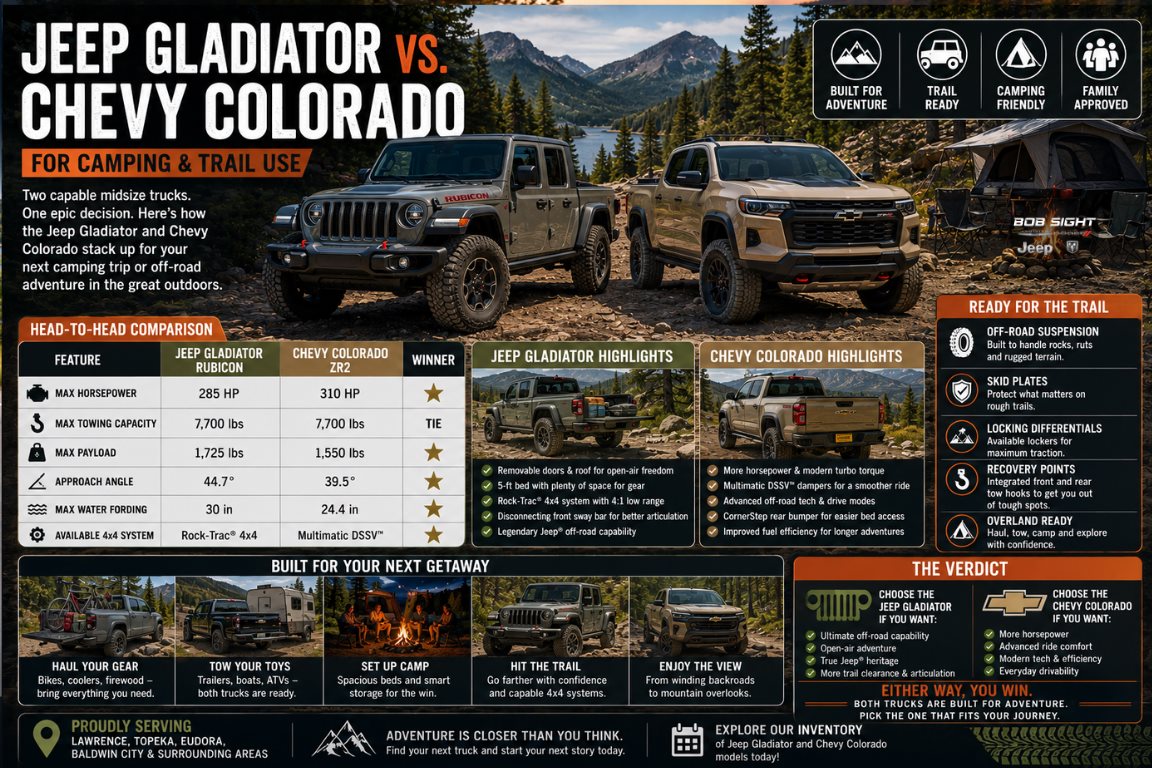
Choosing between the Jeep Gladiator and Chevrolet Colorado for outdoor camping and off-road trail driving requires comparing solid-axle articulation, 4x4 transfer case gearing, bed utility features, and overland gear payload limits. Whether you are packing a rooftop tent for a long weekend at Clinton State Park, navigating rutted mud trails near the Wakarusa River in Douglas County, or taking an extended overlanding trip across the Midwest, selecting the right midsize pickup determines how comfortably you travel and how far off the grid you can go. At Bob Sight CDJR in Lawrence, Kansas, our sales and service specialists help local outdoor enthusiasts compare leading off-road midsize trucks like the Jeep Gladiator and Chevrolet Colorado so you can pick the ultimate rig for your lifestyle and budget.
Off-road trail driving across changing Kansas seasons presents distinct challenges, from deep spring clay mud near Eudora to rocky ledges and rutted forest paths. outdoor families require a truck that combines open-air freedom, heavy-duty underbody protection, high ground clearance, and reliable 4x4 traction. Evaluating approach and departure angles, axle design, bed tie-down systems, and towing thresholds enables drivers across Lawrence, Topeka, and the Kansas City metro to make an informed investment. Exploring key technical specifications and real-world camping scenarios demonstrates why the Jeep Gladiator stands out as the ultimate open-air adventure pickup.
In This Guide You'll Learn
Here is what Kansas outdoor enthusiasts will discover when comparing the Jeep Gladiator against the Chevy Colorado:
- How the Jeep Gladiator 3.6-liter Pentastar V6 and solid Dana 44 axles compare in trail durability to the Chevy Colorado 2.7-liter Turbocharged inline-four.
- Key mechanical differences between Jeep Command-Trac/Rock-Trac 4x4 systems and Chevy Autotrac 4WD.
- Open-air versatility features, including removable doors, fold-down windshield, and soft/hardtop options unique to the Gladiator.
- Overland camping bed setup comparison: payload capacities, rooftop tent fitment, in-bed power outlets, and tie-down hardware.
- Step-by-step procedures for outdoor drivers evaluating 4x4 engagement, trail cameras, and suspension flex during a test drive.
- Step-by-step financial guidance on trade-in valuations, auto loan interest rates, and transparent out-the-door truck pricing.
- Long-term preventive maintenance practices to protect 4x4 transfer cases, solid axles, and underbody skid plates after mud and trail use.
- Answers to frequently asked questions regarding Jeep Gladiator vs Chevy Colorado towing, fuel economy, and off-road safety.
What Key Features Define an Ideal Camping and Trail Truck?
An ideal off-road camping truck must combine reliable four-wheel-drive traction, robust suspension articulation, generous underbody ground clearance, and flexible bed organization for heavy outdoor gear. Campers heading out to rural sites along Highway 10 or US Highway 59 need a pickup that drives smoothly on paved highways while offering serious mechanical hardware the moment tires hit unpaved soil or rocky trails.
Suspension architecture plays a massive role in off-road capability. Solid front and rear axles, like those found on the Jeep Gladiator, keep all four tires firmly planted against uneven terrain during extreme suspension flex, delivering continuous mechanical grip over deep ruts and boulders. Independent front suspension setups, found on trucks like the Chevy Colorado, offer a smooth ride on paved roads but sacrifice front wheel articulation and ground clearance under full suspension compression.
Bed cargo utility and overland gear compatibility are equally crucial for multi-day camping trips. Outdoor drivers need a truck bed that easily accepts bed racks, rooftop tents, slide-out camp kitchens, and heavy coolers without exceeding payload ratings. Built-in bed tie-down cleats, integrated 115-volt power outlets, and weather-protected bed steps ensure that packing and setting up camp at night remains effortless.
Jeep Gladiator vs Chevy Colorado: Performance and Trail Powertrains
The Jeep Gladiator comes standard with the proven 3.6-liter Pentastar V6 engine producing 285 horsepower and 260 lb-ft of torque, paired with solid Dana 44 front and rear axles and an available 6-speed manual or 8-speed automatic transmission. In contrast, the Chevy Colorado relies on a single 2.7-liter turbocharged 4-cylinder engine (producing 237 to 310 horsepower depending on trim tuning) paired exclusively with an 8-speed automatic transmission and an independent front suspension.
While the Colorado's turbocharged engine delivers strong low-end torque on paper, the Jeep Gladiator offers distinct advantages on remote trails where mechanical simplicity, durability, and gear control matter most. The Gladiator offers an available 6-speed manual transmission, giving off-road purists total manual control over crawl speeds when descending steep, slippery hills or crawling over rocks near Clinton Lake. Furthermore, the Gladiator Rubicon delivers a best-in-class crawl ratio of up to 84:1 (manual) or 77:1 (automatic), allowing the truck to creep over obstacles at a slow, controlled walk without riding the brakes.
For outdoor families who pull ski boats down to Lake of the Ozarks or haul heavy pop-up campers to the Flint Hills, towing capability remains top-of-mind. The Jeep Gladiator boasts a maximum towing capacity of up to 7,700 pounds when properly equipped, outperforming the Chevy Colorado maximum towing limit of 7,700 pounds on select trims while offering superior tongue weight support through its long 137.3-inch wheelbase.
Open-Air Freedom vs Conventional Cab Design
The Jeep Gladiator is the only open-air pickup truck in the automotive industry, featuring standard removable doors, a fold-down windshield, and multiple removable soft top and hardtop configurations. No other midsize pickup, including the Chevy Colorado, offers the immersive outdoor experience of stripping away doors and roof panels to feel the breeze while trail riding through Kansas woods.
Removing the lightweight aluminum doors and Freedom Top hardtop panels takes only minutes using the provided factory tool kit. For outdoor drivers who want instant open-air access without removing hardtop panels, the available Sunrider for Hardtop or Sky One-Touch Power Top opens the roof above front and rear passengers at the touch of a button. The interior of the Gladiator is engineered specifically for active outdoor lifestyles, featuring weather-resistant push-button start, available marine-grade washable floor carpets with removable drain plugs, and water-resistant interior electrical controls.
The Chevy Colorado features a traditional fixed-roof, fully enclosed cab layout. While it offers a quiet passenger cabin for daily highway commutes around Overland Park, it lacks any option for removable tops, doors, or washable floor drains. For drivers who view the journey as part of the outdoor camping experience, the Jeep Gladiator delivers an unmatched connection to nature.
All-Terrain 4x4 Traction: Jeep Rock-Trac vs Chevy Autotrac
Jeep 4x4 transfer case systems incorporate Tru-Lok electronic front and rear locking differentials, electronic front sway bar disconnects, and Rock-Trac heavy-duty transfer cases to provide industry-leading off-road traction. Standard on Gladiator Rubicon models, the Rock-Trac 4x4 system features a 4:1 low-range gear ratio that quadruples engine torque delivered to the wheels for extreme crawling capability.
A major mechanical advantage of the Gladiator Rubicon on technical trails is its electronic front sway bar disconnect. At the push of a dash button, the front sway bar disengages, allowing the front axle to flex up to 30 percent further. This extra articulation keeps tires on the ground across deep offset ruts that would leave independent front suspension trucks like the Colorado hanging a tire in mid-air. Standard Tru-Lok electronic locking differentials mechanically lock left and right axle shafts together, splitting engine power 50/50 so the truck keeps moving forward even if three wheels lose grip on slick mud or ice.
The Chevy Colorado offers an available Autotrac 2-speed transfer case and an available driver-selectable rear locker on Z71 models, with front and rear lockers reserved for top-tier ZR2 trims. While the ZR2 is capable, its independent front suspension lacks the raw wheel travel and trail durability of solid Dana 44 axles. The advanced 4x4 hardware of the Jeep Gladiator guarantees superior driver confidence whether tackling unpaved backroads or navigating severe winter weather along Interstate 70.
Camping Utility and Bed Comparison: Gladiator vs Colorado
The Jeep Gladiator bed is engineered specifically for overlanding gear, featuring a 5-foot steel bed floor with integrated tie-down cleats, available 115-volt bed power outlet, three-position dampening tailgate, and a payload capacity of up to 1,725 pounds. Managing camping gear requires a bed layout that accommodates heavy loads without sagging or compromising rear suspension geometry.
The comparison table below outlines key operational specifications across the Jeep Gladiator and Chevy Colorado:
| Vehicle Model | Front / Rear Axle Architecture | Standard Engine / Transmission | Max Towing Capacity | Max Payload Rating |
|---|---|---|---|---|
| Jeep Gladiator | Solid Dana 44 Front & Rear Axles | 3.6L V6 (285 HP) / 6-Speed Manual or 8-Speed Auto | 7,700 lbs | 1,725 lbs |
| Chevy Colorado | Independent Front / Solid Rear Axle | 2.7L Turbo 4-Cyl (237-310 HP) / 8-Speed Auto | 7,700 lbs | 1,710 lbs |
Evaluating the Gladiator bed against the Chevy Colorado reveals distinct design advantages for overlanding. The Gladiator features flat-topped rear fender flares designed to support heavy side gear, while its 1,725-pound maximum payload rating allows campers to install heavy rooftop tent racks, slide-out refrigerators, and extra fuel canisters without exceeding Gross Vehicle Weight Ratings (GVWR). Furthermore, the Gladiator under-seat storage bins inside the cabin lock securely with the ignition key, keeping expensive camera gear, handguns, or tools safe when the doors are off at a campsite.
Step-by-Step Guide: How Kansas Trail Drivers Should Test-Drive an Off-Road Truck
Testing an off-road pickup during a comprehensive test drive involves evaluating 4x4 transfer case engagement, suspension bump compliance, forward visibility over the hood, and low-speed crawl control. Following a structured evaluation routine allows drivers to experience how a truck performs in real-world trail conditions rather than relying solely on brochure numbers.
Follow these six step-by-step procedures when test-driving a Jeep Gladiator at Bob Sight CDJR:
- Test 4x4 Transfer Case Engagement: Shift from 2H into 4H High and 4L Low at a slow roll (1-3 mph) on an unpaved gravel area to evaluate smooth mechanical transfer case engagement and low-range gear reduction.
- Evaluate Forward TrailCam Visibility and Screen Displays: Activate the available forward-facing TrailCam on the 12.3-inch Uconnect touchscreen to check how clearly ground obstacles immediately in front of the bumper are displayed.
- Check Low-RPM Engine Torque and Crawl Speed: Drive over uneven terrain at 2 to 5 miles per hour in 4L Low to evaluate smooth throttle progression and low-speed crawling control without brake ride.
- Assess Axle Articulation over Ruts and Bumps: Drive over speed humps or diagonal drainage ruts along Kasold Drive at 15 mph to gauge how solid Dana 44 axles absorb impacts and keep body motion controlled.
- Inspect Bed Utility and Under-Seat Locking Storage: Lower the three-position tailgate, inspect the 115-volt bed power outlet, and test the lockable rear under-seat storage compartment using the ignition key.
- Test Open-Air Freedom and Freedom Top Panel Removal: Practice unlatching and removing the front Freedom Top hardtop panels to evaluate how quickly you can convert the cab to open-air mode.
Completing these evaluation steps provides immediate clarity on which truck best supports your outdoor hobbies. Our knowledgeable sales specialists at Bob Sight CDJR encourage thorough hands-on testing so you can feel completely confident in your purchase decision.
Step-by-Step Guide: Evaluating Trade-In Equity and Out-The-Door Truck Pricing
Evaluating your total purchase cost requires establishing your current trade-in equity allowance, securing competitive auto loan interest rates, and obtaining an itemized out-the-door price quote. Establishing a clear budget before finalizing your deal eliminates financial stress and ensures monthly payments fit your household goals.
Follow these five step-by-step procedures to evaluate your trade-in and auto financing options:
- Determine Your Current Vehicle Trade-In Value: Plain-language definition: Trade-in value is the net monetary allowance offered by a dealership for your pre-owned vehicle, which applies directly as a down payment toward your purchase to lower your overall loan principal balance.
- Request an Itemized Out-The-Door Price Estimate: Plain-language definition: Out-the-door pricing represents the final complete purchase cost including the agreed vehicle sale price, state sales taxes, local Douglas County title and registration fees, and dealership documentation charges with zero hidden fees.
- Calculate Your Net Down Payment and Finance Principal: Combine your trade-in equity credit with any additional cash down payment to calculate the exact principal balance requiring auto financing through Chrysler Capital or local credit unions.
- Evaluate Loan Term Options and Annual Percentage Rates (APR): Compare monthly payment structures across 48, 60, or 72-month terms, paying close attention to the interest rate (APR) to minimize total interest paid over the life of the loan.
- Factor in Annual Insurance and Scheduled Maintenance Costs: Obtain an auto insurance quote for your target Gladiator trim and factor in routine synthetic oil changes, tire rotations, and 4x4 fluid service to establish your complete monthly vehicle budget.
Taking a structured approach to auto financing eliminates unexpected surprises at signing. Our finance specialists at Bob Sight CDJR work transparently with local Kansas banks and national lenders to secure competitive interest rates and clear out-the-door pricing tailored to your household budget.
Quick Facts: Jeep Gladiator vs Chevy Colorado Comparison
- Exclusive Open-Air Design: Jeep Gladiator features standard removable doors, fold-down windshield, and soft/hardtop options; Chevy Colorado has a fixed steel roof.
- Solid Axle Durability: Jeep Gladiator utilizes heavy-duty solid Dana 44 front and rear axles for ultimate suspension flex; Colorado uses an independent front suspension.
- Available Manual Transmission: Jeep Gladiator offers a 6-speed manual transmission with up to an 84:1 crawl ratio; Chevy Colorado is automatic-only.
- Max Towing Rating: Both midsize pickups offer up to a 7,700-pound maximum towing capacity when properly equipped.
- Washable Interior: Jeep Gladiator features available washable carpet floor coverings with removable floor drain plugs for easy post-trail cleanup.
These key specifications highlight why the Jeep Gladiator represents a feature-rich, high-value choice for Kansas drivers seeking open-air fun, serious 4x4 engineering, and daily pickup versatility. Visiting Bob Sight CDJR in Lawrence allows you to compare trim options, test-drive different transmissions, and explore live showroom inventory.
Long-Term Maintenance Strategy for Trail and Off-Road Pickups
Maintaining long-term truck reliability, 4x4 transfer case health, and suspension joint life requires adhering to factory scheduled maintenance, using OEM replacement fluids, and cleaning underbody components after off-road use. Driving a pickup through clay mud, water crossings, and dusty trails subjects axle seals, brake rotors, and steering linkages to continuous wear. Establishing a consistent maintenance routine preserves vehicle safety and protects resale value.
Engine oil care is especially critical for vehicles driven on slow-speed off-road trails. Utilizing full synthetic engine oil, such as 0W-20 viscosity formulations, protects internal cylinder walls and valvetrain components from thermal breakdown during high-load, low-speed trail driving. Changing synthetic oil and rotating tires every 5,000 to 7,500 miles ensures uniform tire tread wear, protects suspension alignment, and optimizes highway fuel mileage.
Drivetrain and underbody upkeep is equally vital after mud and trail excursions. Washing heavy clay mud from underbody skid plates, driveshaft universal joints, and brake assemblies prevents severe wheel imbalance and premature seal corrosion. Inspecting front and rear differential gear oils and transfer case lubricants after deep water crossings ensures no water contamination has occurred. Utilizing genuine Mopar replacement parts and factory-approved synthetic lubricants guarantees complete mechanical reliability. Our certified service center at Bob Sight CDJR provides fast Express Lane maintenance to make routine upkeep simple and convenient.
Frequently Asked Questions About Jeep Gladiator vs Chevy Colorado in Kansas
Which midsize truck is better for rock crawling and mud trail driving in Kansas?
The Jeep Gladiator is significantly better for rock crawling and mud trail driving because its solid Dana 44 front and rear axles, electronic front sway bar disconnect, and Tru-Lok locking differentials deliver superior axle articulation and mechanical grip. Unlike the independent front suspension on the Chevy Colorado, which limits front tire droop over deep ruts, solid Dana axles keep all four tires pressed firmly against uneven ground. Furthermore, the Gladiator Rubicon features a 4:1 low-range transfer case and up to an 84:1 crawl ratio, allowing it to crawl smoothly over rocks and deep mud near the Wakarusa River without stalling or slipping tires.
Pro-Tip from the Bob Sight CDJR Service Bay: After driving through thick clay mud near Clinton Lake, wash your truck underbody thoroughly with a high-pressure hose. Clearing mud from driveshafts, brake calipers, and wheels prevents high-speed highway vibrations along Interstate 70.
Can you remove the doors and roof on a Chevy Colorado like you can on a Jeep Gladiator?
No, you cannot remove the doors or roof on a Chevy Colorado, as it features a conventional welded steel cab structure. The Jeep Gladiator is the only open-air pickup truck on the market with standard removable doors, a fold-down windshield, and multiple soft top or hardtop choices. Removing the lightweight aluminum doors and Freedom Top roof panels on the Gladiator takes just minutes using the provided tool kit, providing an open-air driving experience across Kansas backroads that no conventional truck can match.
Pro-Tip from the Bob Sight CDJR Service Bay: When taking the doors off your Jeep Gladiator, store them safely inside protective door storage bags and use the built-in bolt storage tray located under the rear seat to keep hinge screws organized.
How does towing capacity compare between the Jeep Gladiator and Chevy Colorado?
Both the Jeep Gladiator and Chevy Colorado offer a maximum towing capacity of up to 7,700 pounds when properly equipped, making both trucks capable of pulling travel trailers, ski boats, or utility loads. The Gladiator achieves its 7,700-pound rating when equipped with the 3.6-liter Pentastar V6, 8-speed automatic transmission, 4.10 rear axle ratio, and Max Tow Package. Its long 137.3-inch wheelbase provides excellent highway trailer stability when towing along K-10 or Interstate 35 toward Oklahoma.
Pro-Tip from the Bob Sight CDJR Service Bay: When hauling heavy campers, always verify your trailer tongue weight equals roughly 10 to 15 percent of total loaded trailer weight to preserve rear suspension control and headlight alignment.
Is the Jeep Gladiator comfortable enough for daily family highway commuting?
Yes, the Jeep Gladiator is remarkably comfortable for daily family commuting, featuring a five-link coil suspension system at all four corners, a spacious Crew Cab with generous rear legroom, and modern Uconnect 5 touchscreen technology. While older body-on-frame trucks relied on stiff rear leaf springs, the rear coil-spring suspension on the Gladiator absorbs highway expansion joints smoothly along Highway 10 and Kasold Drive. Available interior luxuries like heated leather seats, alpine premium audio, wireless Apple CarPlay, and Adaptive Cruise Control make long highway shifts effortless.
Pro-Tip from the Bob Sight CDJR Service Bay: Maintain recommended cold tire pressures listed on your driver door placard (typically 37 to 40 PSI) to optimize highway fuel efficiency and ensure smooth tread wear on all-terrain tires.
What factory warranty coverage comes with a new Jeep Gladiator at Bob Sight CDJR?
Every new Jeep Gladiator purchased at Bob Sight CDJR includes a 3-year/36,000-mile Basic Bumper-to-Bumper Limited Warranty and a 5-year/60,000-mile Powertrain Limited Warranty with 24/7 Roadside Assistance. The powertrain warranty covers vital mechanical components including the 3.6L Pentastar V6 engine, transmissions, transfer cases, driveshafts, and solid Dana 44 axles. Furthermore, factory rust-through corrosion coverage protects outer body sheet metal for 5 years or 100,000 miles.
In addition to factory warranty protection, purchasing your truck from Bob Sight CDJR provides access to our certified service department, factory-trained technicians, and authentic Mopar parts. Our team is dedicated to providing transparent service and long-term support throughout your vehicle ownership journey.
Pro-Tip from the Bob Sight CDJR Service Bay: Keep documented records of all scheduled maintenance visits, including synthetic oil changes, tire rotations, and 4x4 fluid services. Maintaining complete service records preserves your factory warranty protection and maximizes trade-in value when you decide to upgrade in the future.
Why Buying Local at Bob Sight CDJR Matters for Kansas Outdoor Drivers
Purchasing and servicing your adventure pickup at Bob Sight CDJR in Lawrence guarantees personalized customer care, transparent market pricing, and long-term service support from a trusted family-owned local auto group. Conveniently located at 2300 W 29th Terrace in Lawrence, KS, our sales team understands local outdoor priorities, trail access routes, and Midwest weather demands, ensuring you receive honest recommendations tailored to your household budget.
Our commitment to local drivers extends well beyond initial vehicle delivery. The Bob Sight CDJR service center is equipped with state-of-the-art diagnostic machinery, factory-certified technicians, and a vast inventory of genuine Mopar OEM parts engineered specifically for Chrysler, Dodge, Jeep, and Ram vehicles. Whether your truck requires routine synthetic oil changes, tire rotations, brake pad replacements, or complex 4x4 drivetrain maintenance, our Express Lane service bays provide fast, dependable care that fits your busy schedule.
We invite outdoor enthusiasts and family buyers across Douglas County, Topeka, Eudora, Baldwin City, and the greater Kansas City metro area to visit Bob Sight CDJR in Lawrence, KS today. Take an extended test drive, experience the open-air Gladiator cabin and solid-axle performance, explore our live showroom inventory, speak with our finance specialists, and discover why generations of Kansas drivers trust Bob Sight CDJR for all their automotive needs.
Helpful Links
- Browse New Jeep Gladiator Inventory in Lawrence, KS
- Explore All New Vehicle Inventory at Bob Sight CDJR
- Value Your Trade-In Vehicle Online at Bob Sight CDJR
- Schedule Certified Jeep Service in Lawrence, KS
- Apply for Auto Financing Online at Bob Sight CDJR
Proud to be Part of the Bob Sight Auto Group
Bob Sight CDJR is proud to be part of the Bob Sight Auto Group, a family-owned network of automotive dealerships serving communities across Kansas and Missouri for generations. Built on a foundation of integrity, transparent pricing, exceptional vehicle selection, and dedicated customer service, our auto group takes pride in supporting local drivers throughout the region. Learn more about our full dealership network below: