Jeep Compass vs Toyota RAV4 for Kansas Families
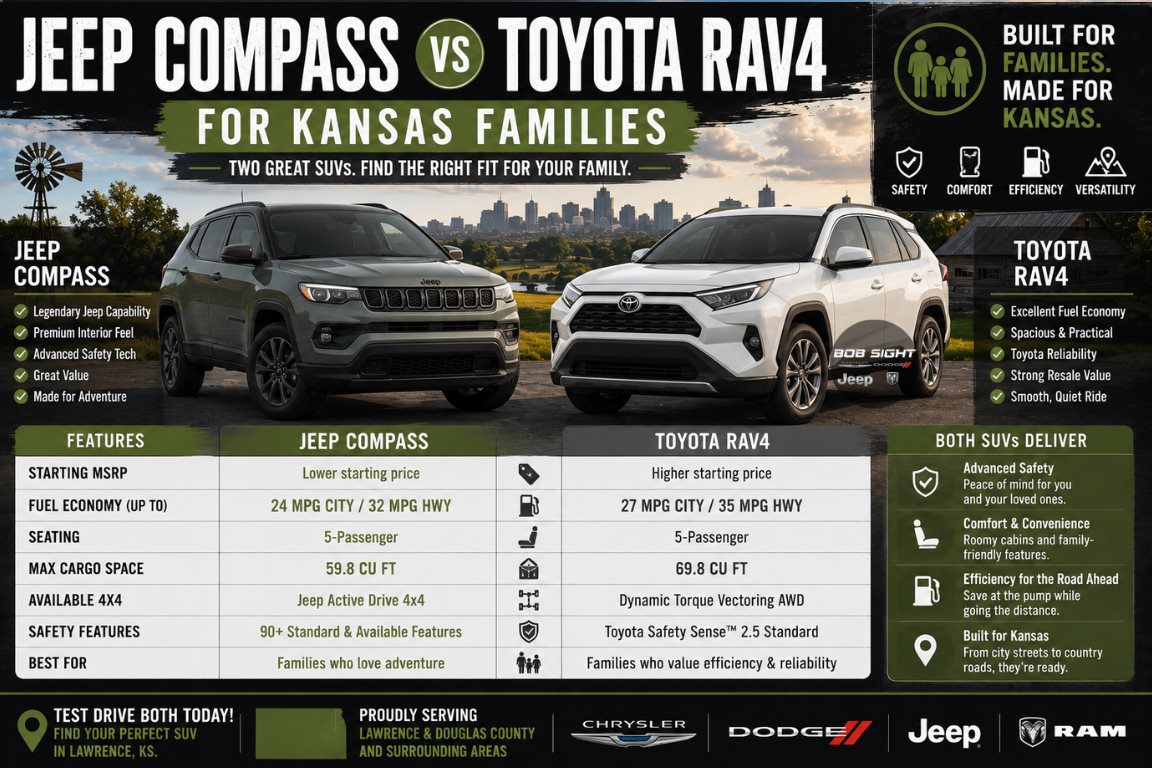
Explore Family-Ready 4x4 Capability: Browse New Jeep Compass Inventory at Bob Sight CDJR in Lawrence, KS
Choosing the right compact SUV for your family in Kansas requires evaluating standard 4x4 capability, turbocharged engine responsiveness, cabin comfort, and overall long-term value for daily commutes and weekend road trips. Navigating morning school drop-offs along Iowa Street, commuting across Douglas County on Highway 10 toward Overland Park, or heading out for family camping trips at Clinton State Park demands a vehicle that adapts effortlessly to changing weather and road conditions. At Bob Sight CDJR in Lawrence, Kansas, we help local parents compare top market contenders like the Jeep Compass and Toyota RAV4 so you can make an informed decision for your household. While both crossovers are popular choices among Midwest drivers, a detailed side-by-side comparison reveals significant differences in standard all-weather capability, low-end engine torque, interior technology, and standard safety features.
Midwest weather patterns present unique driving challenges, ranging from sudden spring thunderstorms near Eudora to freezing rain and drifting snow along Interstate 70 between Lawrence and Topeka. Families need a vehicle that delivers consistent traction, comfortable seating ergonomics for growing children, versatile cargo space for sports equipment, and intuitive infotainment technology to keep everyone connected. By studying engine architectures, four-wheel-drive transfer cases, cabin dimensions, and long-term maintenance needs, local buyers can determine which crossover offers superior daily capability and passenger satisfaction. Exploring these crossover models in detail demonstrates why the Jeep Compass stands out as a compelling value for Kansas families.
In This Guide You'll Learn
Here is what Kansas families will discover when comparing the Jeep Compass and Toyota RAV4:
- How the Jeep Compass standard 2.0-liter turbocharged engine compares in torque and horsepower to the Toyota RAV4 naturally aspirated 2.5-liter engine.
- Key differences between Jeep Active Drive 4x4 with Selec-Terrain management and standard Toyota all-wheel drive systems.
- Interior passenger room, cargo dimensions, and child seat installation flexibility in both compact crossovers.
- Standard infotainment features, touchscreen sizes, and driver assistance technologies designed for Midwest commuting.
- A step-by-step test drive evaluation process tailored specifically for local families shopping in Douglas County.
- Step-by-step guidance on calculating financing basics, trade-in valuations, and out-the-door pricing expectations.
- Long-term preventive maintenance routines to preserve vehicle reliability across seasonal Midwest weather swings.
What Features Define a Family-Friendly Compact SUV in Kansas?
A family-friendly compact SUV must deliver standard all-weather traction, responsive engine acceleration, flexible cargo configurations, and high-definition driver safety technologies to handle daily Midwest driving. Parents navigating busy corridors like 23rd Street in Lawrence or commuting on I-35 need a vehicle that accelerates confidently onto highway entrance ramps while maintaining a quiet, insulated cabin environment. Furthermore, unpredictable seasonal weather across eastern Kansas requires standard four-wheel drive or all-wheel drive that automatically adjusts to slick pavement, slush, or gravel without requiring manual driver intervention.
Interior cabin design plays an equally vital role during daily family transportation. A well-designed crossover provides wide rear door openings for easy child safety seat installation, ample rear legroom for growing teenagers, and durable interior materials that resist accidental spills and dirt. Ample rear cargo volume allows parents to store strollers, sports gear, camping supplies, or weekly groceries without crowding rear passengers. Modern infotainment features, such as wireless Apple CarPlay, Android Auto, multiple USB charging ports, and intuitive touchscreens, ensure that turn-by-turn navigation and entertainment remain effortlessly accessible during multi-hour highway drives.
Finally, safety engineering remains a top priority for parents evaluating vehicles for family travel. Advanced driver assistance systems like Full-Speed Forward Collision Warning with Active Braking, Blind Spot Monitoring, and LaneSense Lane Departure Warning provide constant oversight during busy traffic conditions. Vehicles built with high-strength steel unibody frames and comprehensive airbag protection offer peace of mind whether traveling across town to Baker University events in Baldwin City or driving across state lines toward the Ozark Mountains.
Engine Performance and Drivetrain: Jeep Compass 2.0L Turbo vs Toyota RAV4 2.5L
The Jeep Compass features a standard 2.0-liter turbocharged four-cylinder engine producing 200 horsepower and 221 lb-ft of torque, delivering significantly more low-end pulling power than the Toyota RAV4 standard 2.5-liter engine. Power delivery at lower engine speeds is crucial when merging into fast-moving traffic along K-10 or passing slower agricultural vehicles on rural Douglas County roads. While the Toyota RAV4 naturally aspirated 2.5-liter four-cylinder engine generates 203 horsepower, its lower torque output of 184 lb-ft requires higher engine revolutions per minute (RPM) to achieve peak responsiveness, resulting in additional engine noise during hard acceleration.
Transmission calibration further enhances the driving dynamics of the Jeep Compass. Every new Jeep Compass pairs its 2.0-liter turbocharged engine with a smooth-shifting eight-speed automatic transmission designed to hold gears efficiently under load. This powertrain combination achieves an EPA-estimated 24 MPG city and 32 MPG highway, balancing brisk acceleration with impressive fuel efficiency for daily school commutes and regional travel. In contrast, the Toyota RAV4 utilizes an eight-speed automatic that can occasionally feel gear-hesitant during rapid throttle changes when climbing incline grades around Clinton Lake.
For families who require towing capability for small utility trailers, pop-up campers, or personal watercraft, engine torque makes a substantial difference in vehicle stability. The Jeep Compass comes factory-rated to tow up to 2,000 pounds when properly equipped, backed by its high-torque turbocharged engine that maintains pulling power without straining. The standard Toyota RAV4 non-Adventure trims feature a lower 1,500-pound towing threshold, limiting its versatility for active families who enjoy hauling recreational gear across Kansas and Missouri.
Interior Cabin Comfort, Cargo Flexibility, and Passenger Space
The Jeep Compass offers a modern interior featuring a standard 10.1-inch Uconnect 5 touchscreen display, superior rear shoulder room, and premium seating upholstery that elevates daily passenger comfort. Designing an ergonomic cabin requires maximizing usable passenger volume while providing easy access to climate controls and media options. The Jeep Compass provides 100 cubic feet of total passenger volume, giving front and rear occupants generous head, shoulder, and hip room during long drives across Shawnee and Douglas counties.
When comparing touchscreen technology, the Jeep Compass holds a distinct competitive edge over the entry-level Toyota RAV4. The standard Uconnect 5 system in the Compass boasts a crisp 10.1-inch high-definition display featuring wireless Apple CarPlay, Android Auto, customizable driver profiles, and dual-phone Bluetooth connectivity. Base models of the Toyota RAV4 come equipped with a smaller 8.0-inch touchscreen interface, requiring buyers to step up to higher, more expensive trim tiers to get an enlarged display screen.
Cargo management is another area where both crossovers serve local families well, though each prioritizes space differently. The Jeep Compass offers 27.2 cubic feet of dedicated rear cargo space behind the second row, expanding to 59.0 cubic feet when the 60/40 split-folding rear seats are folded flat. Additionally, the Compass features a fold-forward front passenger seat on select trims, allowing owners to transport extra-long items like ladders, lumber, or kayaks inside the enclosed cabin. While the Toyota RAV4 offers slightly higher maximum cargo volume metrics on paper, the practical rectangular shape and low liftover height of the Compass cargo floor make loading heavy coolers and athletic gear exceptionally straightforward.
All-Weather Traction: Jeep Active Drive 4x4 vs Toyota All-Wheel Drive
Jeep Active Drive 4x4 comes standard on every new Jeep Compass, offering a full-time automatic four-wheel drive system equipped with the Selec-Terrain traction management system. Unlike traditional all-wheel drive setups that operate primarily as front-wheel-drive systems and react only after tire slippage occurs, Jeep Active Drive continuously monitors throttle inputs, steering wheel angles, and ambient temperatures. If winter road conditions deteriorate along US Highway 59, the system instantly directs torque to wheels with the highest traction to preserve vehicle stability.
A key advantage of the Jeep Compass is its standard Selec-Terrain dial, which allows drivers to customize 4x4 performance across four distinct driving modes: Auto, Snow, Sand/Mud, and available Rock mode on Trailhawk models. Engaging Snow mode adjusts engine throttle response, recalibrates transmission shift points, and optimizes torque split between front and rear axles to prevent wheel spin on icy morning roads near Mass Street in Lawrence. Toyota RAV4 base models feature a standard electronic all-wheel drive system without specialized terrain modes unless buyers upgrade to higher-tier off-road packages.
For families who enjoy off-grid camping or navigating unpaved agricultural access roads, the Jeep Compass Trailhawk trim delivers class-exclusive off-road engineering. Featuring Jeep Active Drive Low with a 20:1 crawl ratio, raised suspension ground clearance of 8.6 inches, high-strength underbody skid plates, red tow hooks, and 19 inches of water-fording capability, the Compass Trailhawk easily traverses deep mud and rutted trails that would stall standard crossovers like the Toyota RAV4.
Safety Technology and Driver Assistance Features for Midwest Highways
Both the Jeep Compass and Toyota RAV4 prioritize family protection by equipping their vehicles with comprehensive suites of standard active driver safety and collision-avoidance technologies. Modern driver assist features serve as an extra set of eyes on the road, helping drivers avoid accidents during heavy rain, blinding snowstorms, or high-density highway commuting along K-10 and I-70. Standardizing these safety systems across entry-level trims ensures that every family receives essential collision protection.
The Jeep Compass includes an impressive list of standard safety technologies across every trim level, including Full-Speed Forward Collision Warning with Active Braking, Pedestrian and Cyclist Emergency Braking, Blind Spot Monitoring, Rear Cross Path Detection, Active Lane Management, and Drowsy Driver Detection. The Pedestrian and Cyclist Emergency Braking system utilizes radar and camera sensors to detect obstacles in front of the vehicle, applying emergency braking automatically if the driver fails to react in time. Additionally, available Parallel and Perpendicular Park Assist helps drivers maneuver smoothly into tight parking spots along downtown Lawrence streets.
Toyota equips the RAV4 with its Toyota Safety Sense package, which provides comparable safety features like pre-collision warning, lane departure alert, and adaptive cruise control. However, features like Blind Spot Monitoring and Rear Cross Path Detection are often optional extra-cost add-ons on base RAV4 trims, whereas Jeep includes Blind Spot Monitoring as standard equipment on every new Compass. Standardizing blind-spot coverage ensures safer lane changes when passing long tractor-trailers on open Kansas interstates.
Step-by-Step Guide: How Families Can Evaluate Compact SUVs During a Test Drive
Evaluating a family SUV during a test drive involves systematically testing rear-seat child access, highway noise levels, cargo loading height, and emergency braking responsiveness. A structured test drive routine allows parents to experience how a crossover handles real-world family routines rather than relying solely on online specification sheets. Taking the time to test practical features ensures your final vehicle choice keeps your family comfortable for years to come.
Follow these six step-by-step procedures when test-driving a Jeep Compass or Toyota RAV4 at Bob Sight CDJR:
- Test Rear Passenger Room and Child Seat Installation: Bring your family's actual child safety seats or booster seats to the dealership. Install them in the second row to evaluate LATCH anchor accessibility, rear door opening angles, and remaining front-seat legroom.
- Evaluate Low-End Engine Acceleration: Drive the vehicle onto a fast-moving highway like K-10 or US-59. Accelerate firmly from an entrance ramp to evaluate low-RPM engine torque, transmission shift smoothness, and merging confidence.
- Assess Interior Cabin Noise and Acoustic Insulation: Drive over rough pavement or expansion joints at 65 miles per hour to gauge wind noise, tire roar, and suspension dampening inside the passenger cabin.
- Test Parking Maneuverability and Blind Spot Cameras: Practice parallel parking or backing into a narrow parking stall using the rear backup camera and Blind Spot Monitoring system to verify rearward visibility.
- Inspect Rear Cargo Utility and Liftover Height: Open the rear liftgate and load a stroller, athletic bags, or large luggage items to evaluate cargo floor height, tie-down hook placement, and ease of folding the second-row seats flat.
- Explore Infotainment Smartphone Integration: Pair your smartphone via wireless Apple CarPlay or Android Auto to test touchscreen menu responsiveness, voice command accuracy, and audio sound quality across all seating rows.
Completing these simple evaluation steps provides immediate clarity on which vehicle best supports your daily family routine in Lawrence. Our knowledgeable sales specialists at Bob Sight CDJR encourage thorough hands-on testing so you can feel completely confident in your purchase decision.
Step-by-Step Guide: Calculating Total Cost of Ownership and Financing Basics
Calculating your total cost of vehicle ownership requires evaluating the total purchase price, estimated trade-in equity allowance, available finance interest rates, and expected maintenance costs. Establishing a clear budget before finalizing your purchase prevents financial stress and ensures your monthly payments remain well within your household comfort zone. Understanding fundamental auto finance terminology empowers buyers during lease or loan negotiations.
Follow these five step-by-step financial evaluation procedures when preparing to buy your next family SUV:
- Determine Your Current Vehicle Trade-In Value: Plain-language definition: Trade-in value is the net monetary allowance offered by a dealership for your current pre-owned vehicle, which applies directly as a down payment toward your purchase to reduce your total loan principal balance.
- Request an Itemized Out-The-Door Price Estimate: Plain-language definition: Out-the-door pricing represents the final, complete purchase cost including the agreed vehicle sale price, state sales taxes, local Douglas County title and registration fees, and dealership documentation charges with zero surprise fees.
- Calculate Your Down Payment and Net Loan Balance: Combine your trade-in equity allowance with any cash down payment to calculate the exact principal amount requiring auto financing through Chrysler Capital or a local credit union.
- Evaluate Loan Term Lengths and Annual Percentage Rates (APR): Compare monthly payment structures across 48, 60, or 72-month financing terms, paying close attention to the interest rate (APR) to minimize total interest paid over the life of the loan.
- Factor in Long-Term Insurance and Routine Maintenance Costs: Obtain an auto insurance premium quote for your target crossover and factor in routine oil changes, tire replacements, and brake upkeep to establish your complete monthly vehicle budget.
Taking a structured approach to auto financing eliminates unexpected surprises at signing. Our finance specialists at Bob Sight CDJR work transparently with local Kansas banks and national lenders to secure competitive loan terms and clear out-the-door pricing tailored to your household needs.
Quick Facts: Jeep Compass vs Toyota RAV4 Comparison
- Standard Engine Torque: Jeep Compass produces 221 lb-ft of low-end torque from its 2.0L Turbo engine, compared to 184 lb-ft from the Toyota RAV4 2.5L engine.
- Standard 4x4 System: Every new Jeep Compass includes standard Jeep Active Drive 4x4 with Selec-Terrain management; RAV4 base trims feature standard front-wheel drive or basic AWD.
- Standard Touchscreen Size: Jeep Compass features a standard 10.1-inch Uconnect 5 touchscreen; entry Toyota RAV4 trims feature a smaller 8.0-inch display screen.
- Standard Blind-Spot Safety: Jeep includes Blind Spot Monitoring and Rear Cross Path Detection as standard equipment on every Compass trim level.
- Off-Road Capability: Jeep Compass Trailhawk features a 20:1 crawl ratio, 8.6 inches of ground clearance, and 19 inches of water-fording depth for superior off-grid travel.
These key specifications highlight why the Jeep Compass represents a feature-rich, high-value choice for Kansas families seeking standard 4x4 capability and modern technology. Visiting Bob Sight CDJR in Lawrence allows you to compare trim options, test-drive the turbocharged engine, and explore live showroom inventory.
Ownership Planning: Long-Term Maintenance and Regional Driving Strategy
Maintaining long-term vehicle dependability and optimal fuel economy requires adhering to factory scheduled service intervals, utilizing OEM replacement parts, and adapting driving habits to seasonal weather shifts. Operating a family SUV across changing Kansas seasons subjects engine oil, braking systems, suspension shocks, and tires to continuous wear. Establishing a consistent maintenance routine with factory-certified technicians preserves vehicle safety and protects your long-term trade-in value.
Engine oil care is especially critical for modern turbocharged engines like the 2.0-liter inline four-cylinder in the Jeep Compass. Utilizing full synthetic engine oil, such as 0W-20 viscosity formulations, protects precision turbocharger bearings and internal cylinder walls from thermal breakdown during high-speed highway driving along I-70. Changing synthetic oil and rotating tires every 5,000 to 7,500 miles ensures uniform tire tread wear, protects suspension alignment, and optimizes highway fuel mileage during summer vacation road trips.
Drivetrain and brake system maintenance is equally essential for families who frequently travel over unpaved gravel roads or icy winter highways in eastern Kansas. Inspecting front and rear differential gear oils, transfer case lubricants, and brake pad thickness prevents fluid oxidation and guarantees maximum stopping power on slick pavement. Utilizing genuine Mopar replacement parts and factory-approved lubricants guarantees complete mechanical compatibility and preserves your original factory warranty coverage. Our certified service center at Bob Sight CDJR provides fast Express Lane maintenance to make routine upkeep simple and convenient.
Frequently Asked Questions About Jeep Compass vs Toyota RAV4 in Kansas
Is the Jeep Compass standard 4x4 better for Kansas winter driving than Toyota RAV4 AWD?
Yes, Jeep Active Drive 4x4 with standard Selec-Terrain management provides superior winter driving control because it allows drivers to engage a dedicated Snow mode that optimizes engine throttle, transmission shifting, and torque distribution for icy roads. Unlike basic all-wheel drive systems found on base Toyota RAV4 models that operate primarily in front-wheel drive and react only after tire slip occurs, Jeep Active Drive continuously monitors road friction and ambient temperatures. When driving along I-70 or K-10 during a sudden freezing rain event, the Jeep system proactively sends torque to rear wheels to prevent slippage before it happens.
Furthermore, Jeep Selec-Terrain allows drivers to select specialized settings for Sand/Mud and available Rock modes, providing tailored traction across diverse Midwest terrain. Standardizing 4x4 across every Compass trim ensures that Kansas families receive full all-weather driving confidence without needing to pay extra for high-tier option packages.
Kansas Seasonal Maintenance Alert: Rapid autumn temperature drops across Douglas and Shawnee counties cause tire pressures to drop by roughly one PSI for every ten-degree drop in outside air temperature. Check your tire inflation weekly during cold spells in Lawrence to maintain proper tire tread contact and maximum winter traction.
Which compact SUV offers better low-end engine acceleration for highway merging?
The Jeep Compass delivers superior low-end engine acceleration because its standard 2.0-liter turbocharged engine generates 221 lb-ft of torque starting at low engine RPM, compared to 184 lb-ft from the Toyota RAV4 naturally aspirated 2.5-liter engine. Torque is the force that moves a vehicle from a complete stop and provides instant pulling power when merging onto fast-moving interstates like I-35 or passing slower traffic on two-lane rural highways. Because the Compass turbocharger builds boost quickly, drivers experience responsive acceleration without needing to floor the pedal or rev the engine high.
The Toyota RAV4 naturally aspirated four-cylinder engine requires higher engine speeds to reach its peak power band, resulting in noticeable engine noise during hard acceleration runs. The combination of high low-end torque and a smooth eight-speed automatic transmission makes the Jeep Compass feel significantly more agile during daily city driving around Lawrence and high-speed highway commuting across eastern Kansas.
Pro-Tip from the Bob Sight CDJR Service Bay: Utilizing recommended 0W-20 synthetic engine oil and replacing your engine air filter every 10,000 miles ensures your Jeep Compass turbocharged engine maintains its crisp throttle response and optimal highway fuel economy.
How do the standard touchscreen sizes compare between the Jeep Compass and Toyota RAV4?
The Jeep Compass features a larger standard 10.1-inch Uconnect 5 high-definition touchscreen display on base models, whereas the standard Toyota RAV4 comes equipped with a smaller 8.0-inch touchscreen interface. The Uconnect 5 interface in the Jeep Compass offers superior visual clarity, customizable home screens, dual-phone Bluetooth connectivity, and wireless integration for both Apple CarPlay and Android Auto. Having a larger central screen makes viewing turn-by-turn navigation maps and selecting audio media significantly easier and less distracting while driving.
To obtain a larger display screen in the Toyota RAV4, buyers must purchase higher, more expensive trim levels or add costly technology upgrade packages. Jeep includes its top-tier 10.1-inch display as standard equipment across the entire Compass lineup, providing high-end technology value directly from the factory.
Pro-Tip from the Bob Sight CDJR Service Bay: Keep your Uconnect 5 system updated by allowing over-the-air (OTA) software updates via Wi-Fi. Regular system updates ensure your wireless smartphone pairing and navigation mapping remain fully optimized.
Can the Jeep Compass handle light off-roading and rural gravel roads in Douglas County?
Yes, the Jeep Compass is engineered to excel on unpaved gravel roads, muddy access trails, and rough agricultural terrain throughout Douglas County thanks to its high ground clearance and robust 4x4 architecture. Standard Compass models feature 8.1 inches of ground clearance and durable suspension dampening that absorbs harsh bumps on dirt routes near Clinton Lake or the Wakarusa River. For serious off-road enthusiasts, the Jeep Compass Trailhawk trim increases ground clearance to 8.6 inches and adds heavy-duty underbody skid plates, off-road suspension tuning, red recovery tow hooks, and 19 inches of water-fording capability.
While the Toyota RAV4 offers capable light-duty all-wheel drive, base models lack underbody protective skid plates and specialized low-range 4x4 crawling gear ratios. The Jeep Compass Trailhawk features an exclusive 20:1 crawl ratio that provides exceptional low-speed control when climbing steep, rutted hills or navigating deep mud that would halt standard crossovers.
Missouri and Kansas Highway Driving Alert: When driving over loose gravel roads around rural Lawrence or Eudora, switch your Jeep Selec-Terrain dial to Sand/Mud mode. This setting adjusts wheel slip thresholds and throttle mapping to maintain straight-line vehicle tracking on loose gravel surfaces.
What warranty coverage comes with a new Jeep Compass at Bob Sight CDJR?
Every new Jeep Compass purchased at Bob Sight CDJR includes a comprehensive 3-year/36,000-mile Basic Bumper-to-Bumper Limited Warranty and a 5-year/60,000-mile Powertrain Limited Warranty with 24/7 Roadside Assistance. The powertrain warranty covers vital mechanical components, including the 2.0-liter turbocharged engine, eight-speed automatic transmission, driveshafts, and 4x4 transfer case assemblies. Additionally, buyers benefit from factory rust-through corrosion protection for up to 5 years or 100,000 miles.
In addition to factory warranty coverage, purchasing your vehicle from Bob Sight CDJR provides access to our certified service department, factory-trained technicians, and authentic Mopar parts. Our dealership team is committed to delivering transparent service, convenient online scheduling, and dedicated support throughout your vehicle ownership journey.
Pro-Tip from the Bob Sight CDJR Service Bay: Keep detailed records of all scheduled maintenance visits, including synthetic oil changes and tire rotations. Maintaining documented service records preserves your factory warranty protection and maximizes trade-in value when you decide to upgrade in the future.
Why Buying Local at Bob Sight CDJR Matters for Kansas Families
Purchasing and servicing your family SUV at Bob Sight CDJR in Lawrence guarantees personalized customer support, community accountability, and long-term service care from a family-owned local business. As a locally grounded dealership serving Lawrence, Topeka, Eudora, Baldwin City, and the greater Kansas City metro area, we prioritize long-term customer relationships over rapid sales quotas. Our experienced team understands local commuting habits, regional weather challenges, and family driving priorities, ensuring you receive honest recommendations tailored to your household budget.
Our commitment to local drivers extends well beyond the initial vehicle delivery. The Bob Sight CDJR service center is equipped with state-of-the-art diagnostic machinery, factory-certified technicians, and a vast inventory of genuine Mopar OEM parts engineered specifically for Chrysler, Dodge, Jeep, and Ram vehicles. Whether your vehicle requires routine synthetic oil changes, tire rotations, brake pad replacements, or multi-point inspections, our Express Lane service bays provide fast, dependable care that fits your busy schedule.
We invite local parents and buyers across Douglas County to visit Bob Sight CDJR in Lawrence, KS today to compare the Jeep Compass firsthand. Take an extended test drive, explore our comprehensive new vehicle inventory, speak with our dedicated finance team, and discover why generations of Kansas families trust Bob Sight CDJR for all their automotive needs.
Helpful Links
- Browse New Jeep Compass Inventory in Lawrence, KS
- Explore All New Vehicle Inventory at Bob Sight CDJR
- Value Your Trade-In Online at Bob Sight CDJR
- Schedule Certified Jeep Service in Lawrence, KS
- Apply for Auto Financing Online at Bob Sight CDJR
Proud to be Part of the Bob Sight Auto Group
Bob Sight CDJR is proud to be part of the Bob Sight Auto Group, a family-owned network of automotive dealerships serving communities across Kansas and Missouri for generations. Built on a foundation of integrity, transparent pricing, exceptional vehicle selection, and dedicated customer service, our auto group takes pride in supporting local drivers throughout the region. Learn more about our full dealership network below: