How Jeep Four-Wheel-Drive Systems Work and When to Use Each Mode for Kansas City Metro Drivers
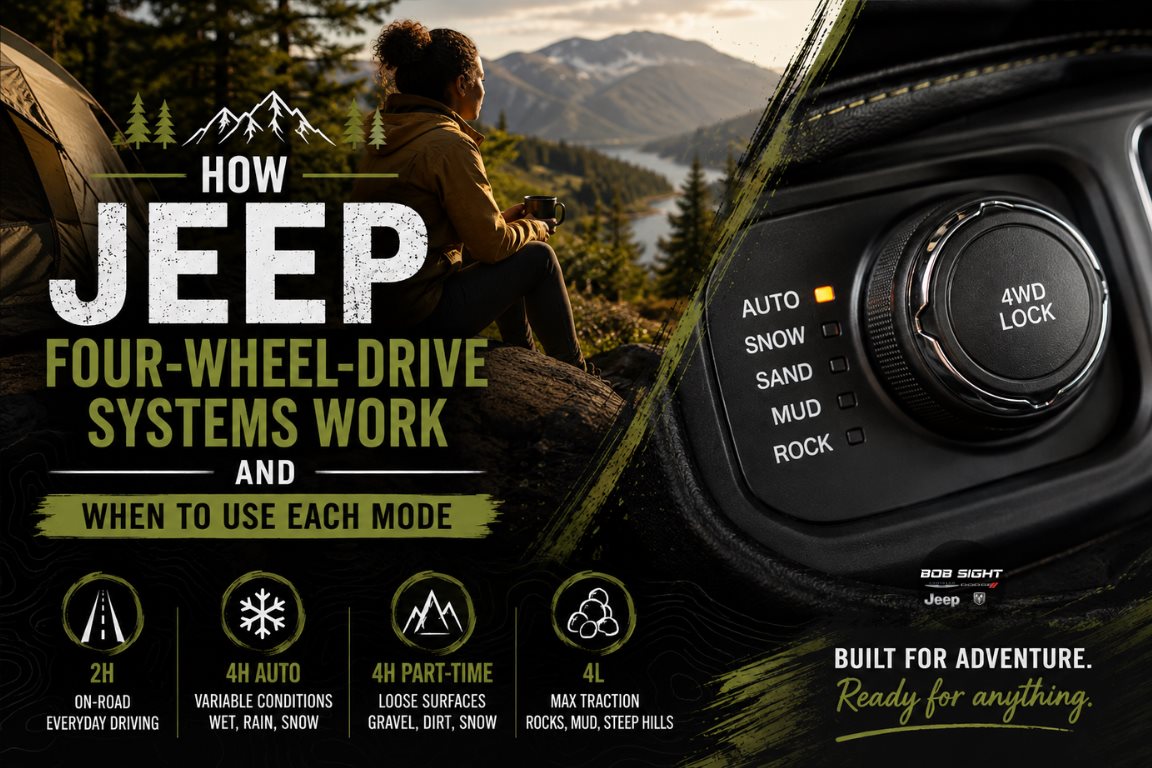
Navigating the unpredictable weather across Douglas County and the greater Kansas City metro requires a clear understanding of how your Jeep vehicle transfer case and four-wheel-drive system operate. Whether you are commuting along Iowa Street during a sudden winter blizzard in Lawrence, tackling slick mud out near Clinton State Park, or highway cruising on Interstate 70 toward Topeka, selecting the proper drive mode ensures maximum traction while protecting your drivetrain from mechanical damage. At Bob Sight CDJR, our team of certified specialists helps local drivers master their vehicles so they can drive with absolute confidence in every seasonal condition.
Explore New Jeep 4x4 Inventory at Bob Sight CDJR
IN THIS GUIDE YOU'LL LEARN:
Here is what this comprehensive guide covers to help you master your Jeep vehicle's 4x4 system:
- The fundamental mechanical differences between part-time 4x4, full-time 4x4, and automatic all-wheel-drive systems.
- How transfer cases, center differentials, and low-range reduction gears split torque between axles.
- Exact operating steps and speed limits for shifting between 2H, 4H, 4H Auto, and 4L.
- How to identify and safely utilize specialized Jeep systems like Command-Trac, Selec-Trac, Rock-Trac, and Quadra-Trac.
- How the Selec-Terrain Traction Management System adjusts throttle, transmission shifts, and electronic stability control.
- Critical local Kansas driving scenarios where specific 4x4 modes prevent binding, wheel slip, or getting stranded.
- Long-term maintenance strategies for transfer case fluid, differential lubricants, and axle seal longevity.
The Mechanical Foundations of Jeep Four-Wheel-Drive Systems
Jeep four-wheel-drive systems function by routing engine torque through a specialized transfer case to split power between the front and rear solid axles or independent driveshafts. Unlike basic all-wheel-drive setups that rely on lightweight hydraulic clutches primarily designed for pavement, authentic Jeep systems utilize heavy-duty mechanical gears, center differentials, and dual-range gear sets to maintain traction across harsh terrain. Understanding whether your vehicle uses a rigid part-time transfer case or an active full-time unit determines how and where you can safely engage four-wheel drive without damaging internal components.
When you shift your transfer case lever or turn a electronic rotary dial, you are mechanically or electronically locking the front and rear driveshafts together. In part-time systems like the Command-Trac NV241, engaging four-wheel drive forces both the front and rear axles to rotate at the exact same speed. On high-traction surfaces like dry asphalt along K-10 highway, this mechanical lock prevents the front and rear tires from rotating at different speeds while turning, causing a severe condition known as drivetrain binding or driveline hop that places intense pressure on U-joints and axle shafts.
Full-time systems, such as Selec-Trac or Quadra-Trac II, feature an internal center differential or an electronically controlled multi-plate wet clutch pack. This design allows the front and rear driveshafts to rotate at variable speeds during turns while continuous torque is supplied to all four tires. During heavy downpours along 23rd Street in Lawrence, an active full-time system automatically senses wheel slippage in milliseconds, sending up to 100 percent of available torque to the axle with the most grip without requiring manual driver intervention.
Understanding Drive Modes: 2H, 4H, 4H Auto, and 4L Explained
Jeep transfer cases offer distinct selectable modes designed for specific surface friction levels, speeds, and torque amplification requirements. Choosing the correct mode ensures your vehicle maximizes fuel economy on smooth highways while delivering maximum mechanical advantage when crawling through deep snow, thick Kansas clay, or rocky trails. Knowing the exact operating parameters of each mode keeps your drivetrain healthy and your vehicle under total control.
Below is a breakdown of the primary Jeep drive modes, their mechanical function, and their ideal local applications:
- 2H (Two-Wheel Drive High): Engine torque is sent entirely to the rear axle, completely disconnecting the front driveshaft in part-time models. This mode minimizes mechanical resistance, optimizes fuel efficiency, and prevents component wear during routine driving on dry pavement across Lawrence and the Kansas City metro.
- 4H (Four-Wheel Drive High Part-Time): The transfer case mechanically locks the front and rear driveshafts in a 50/50 torque split. This mode provides maximum traction on low-friction surfaces like unplowed snow, ice, packed gravel, or deep mud, but must never be engaged on dry asphalt.
- 4H Auto (Four-Wheel Drive High Full-Time/Automatic): The transfer case uses an active clutch system to drive the rear wheels while monitoring wheel slip. When slip occurs, it automatically engages the front axle, making it safe to use on mixed surfaces like patchy black ice on West 6th Street or wet highways.
- 4L (Four-Wheel Drive Low): Torque is routed through an additional planetary gear set within the transfer case, providing a gear reduction ratio such as 2.72:1 or 4.0:1. This multiplies torque significantly at low speeds for maximum pulling power, steep hill climbs, deep mud, or crawling over large obstacles under 25 mph.
Transitioning between these modes requires correct technique to avoid gear clash. Shifting between 2H and 4H can be performed "on-the-fly" at speeds up to 45 or 55 mph, provided the vehicle is traveling in a straight line on a slippery surface. Shifting into 4L requires rolling the vehicle slowly at 1 to 3 mph, placing the transmission in Neutral, and quickly moving the transfer case lever firmly through Neutral directly into 4L before re-engaging Drive or a low manual gear.
Comparing Jeep 4x4 Systems: Command-Trac, Selec-Trac, Rock-Trac, and Quadra-Trac
Jeep manufactures multiple distinct 4x4 systems tailored to different driver profiles, ranging from daily commuters to extreme off-road enthusiasts. Each system incorporates unique transfer case gearing, center differentials, and axle lock capabilities that dictate how torque is delivered to the ground. Identifying which system is equipped on your Jeep Wrangler, Jeep Gladiator, or Jeep Grand Cherokee helps you utilize its full potential.
The standard system on many Wrangler and Gladiator trims is Command-Trac, a robust part-time system utilizing a 2.72:1 low-range gear ratio. Command-Trac is engineered for maximum durability, using a shift-on-the-fly manual lever to engage 4H when pavement gives way to loose gravel or snow. For drivers seeking seamless transition between dry pavement and icy patches, Selec-Trac adds a full-time 4H Auto setting using an internal clutch, allowing you to leave the system in 4WD continuously regardless of road conditions.
For extreme off-roading, the legendary Rock-Trac system equipped on Rubicon models offers an aggressive 4.0:1 low-range gear ratio, Tru-Lok electronic locking front and rear differentials, and an electronic front sway bar disconnect. In 4L, Rock-Trac creates an astonishing crawl ratio up to 84:1 with a manual transmission, allowing the vehicle to walk over massive rocks at less than 1 mph. On luxury models like the Grand Cherokee, Quadra-Trac II utilizes a two-speed active transfer case, while Quadra-Drive II adds a rear Electronic Limited-Slip Differential (ELSD) capable of sending 100 percent of available torque to a single rear wheel with traction.
| Jeep 4x4 System | Type / Operation | Low-Range Gear Ratio | Ideal Driver / Terrain |
|---|---|---|---|
| Command-Trac | Part-Time 4WD (2H, 4H, 4L) | 2.72:1 | Snow, mud, gravel trails, traditional off-roading |
| Selec-Trac | Full-Time / Active 4WD (2H, 4H Auto, 4H Part-Time, 4L) | 2.72:1 | Variable winter weather, commuting, changing pavement conditions |
| Rock-Trac | Heavy-Duty Part-Time or Full-Time with Front/Rear Lockers | 4.00:1 | Extreme off-road crawling, steep inclines, deep mud, rock trails |
| Quadra-Trac II | Active Full-Time All-Speed 4WD with 2-Speed Transfer Case | 2.72:1 | All-weather luxury highway commuting, towing, light off-road |
| Quadra-Drive II | Active Full-Time 4WD with Rear ELSD (Electronic Limited Slip) | 2.72:1 | Maximum all-weather security, severe snow, heavy trail driving |
Mastering the Selec-Terrain Traction Management System
The Jeep Selec-Terrain system calibrates up to 12 individual vehicle subsystem algorithms to optimize vehicle stability across specific ground conditions. Available on models equipped with Quadra-Trac II, Quadra-Drive II, or active drive systems like the Jeep Compass, Selec-Terrain coordinate engine throttle response, transmission shift points, transfer case torque splitting, electronic stability control (ESC), anti-lock brakes (ABS), and traction control with a single turn of a console dial.
Understanding how each setting alters vehicle behavior allows you to dial in the perfect setup for Kansas driving conditions:
- Auto Mode: This is the default setting for standard driving. It monitors traction continuously and automatically engages 4WD when slip is detected, while prioritizing front-wheel or rear-wheel torque delivery on clear roads to maximize overall fuel efficiency.
- Snow Mode: Designed for icy roads and winter storms along US-59, this mode launches the vehicle in second gear to reduce wheel spin, tunes throttle sensitivity for smooth acceleration, and sets a 60/40 front-to-rear torque split for high-speed stability.
- Sand/Mud Mode: Tailored for soft terrain, this setting maximizes wheel spin by loosening traction control thresholds, sharpens throttle response, and keeps transmission gears engaged longer to maintain momentum through sticky mud along rural Douglas County farm roads.
- Rock Mode: Available in 4L on select models, this setting engages Hill Descent Control, locks the rear differential or ELSD, and optimizes ABS algorithms for slow-speed crawling over steep ledges, rock beds, or severe washouts.
- Sport Mode: recalibrates torque distribution to a 20/80 front-to-rear split, stiffens available air suspension damping, and holds transmission shift points longer to provide dynamic handling on dry, twisting paved roads.
By integrating these electronic modes with mechanical transfer case gearing, Jeep vehicles eliminate the guesswork from driving across changing environments. When navigating a sudden freezing rain event on I-70 near Lawrence, switching from Auto to Snow mode instantly changes brake lock differential sensitivity, giving you greater steering control and stability before wheels begin to spin freely.
Step-by-Step Guide: How to Safely Shift Your Jeep Transfer Case
Proper operation of your Jeep mechanical or electronic transfer case prevents gear grinding, transfer case damage, and premature wear on shift linkages. While modern shift-on-the-fly transfer cases allow transitions between two-wheel drive and high-range four-wheel drive at vehicle speed, shifting into low-range requires specific sequence steps to allow internal planetary gears to mesh safely.
Follow these precise step-by-step instructions to safely shift your Jeep into 4H High Range or 4L Low Range:
Shifting From 2H to 4H (High Range On-The-Fly):
- Ensure the vehicle is traveling on a loose or slippery surface such as snow, ice, gravel, or dirt. Do not engage 4H on dry pavement.
- Maintain a steady speed between 0 and 45 mph with the front wheels pointed straight ahead.
- If equipped with a manual lever, pull the transfer case lever firmly back from 2H into the 4H position in one smooth motion. If equipped with a push-button or rotary dial, select 4H or 4H Auto.
- Observe the instrument cluster to confirm the 4WD indicator light illuminates solid, indicating the front axle disconnect has fully engaged.
Shifting From 4H to 4L (Low Range Crawl Mode):
- Slow the vehicle down to a slow coast of 1 to 3 mph. Do not attempt to shift into 4L while completely stopped or moving faster than 5 mph.
- Shift the automatic transmission lever into Neutral (N), or depress the clutch pedal completely on manual transmission models.
- While rolling slowly, pull the transfer case lever firmly and continuously from 4H, through Neutral (N), directly into 4L. Do not pause in the transfer case Neutral position, as this can cause gear teeth to clash against rotating shafts.
- Shift the automatic transmission back into Drive (D) or low gear (1st), and gently apply the accelerator to confirm full mechanical gear engagement. The "4WD LOW" indicator light will illuminate on your dash.
To return from 4L to 4H, repeat the reverse process: coast at 1 to 3 mph, shift the main transmission to Neutral, swiftly push the transfer case lever through N into 4H, and re-engage Drive. Practicing this smooth, decisive motion ensures long component life and effortless off-road operation.
Real-World Kansas Driving Scenarios: When to Use Each Mode
Applying the correct 4x4 mode to specific Eastern Kansas weather events and road conditions prevents drivetrain binding while maintaining optimal traction. The weather around the Kansas City metro and Lawrence can shift rapidly from dry highways to heavy ice, torrential rain, or deep prairie snow. Matching your transfer case selection to the exact road surface keeps you moving safely without risking mechanical failure.
Here are key local driving scenarios and the recommended 4x4 engagement strategy:
Scenario 1: Patchy Winter Snow and Black Ice on I-70 or K-10
When commuting along Highway 10 between Lawrence and Eudora during a winter storm, you will encounter alternating stretches of clear asphalt, slush, and black ice. If your vehicle has a part-time Command-Trac system, keep it in 2H unless the road is continuously covered in snow to prevent drivetrain binding during dry lane changes. If your vehicle is equipped with Selec-Trac or Quadra-Trac, select 4H Auto. This allows the system to send power to the front wheels instantly when ice is struck, while letting the center clutch disengage on dry pavement through the highway curves.
Scenario 2: Heavy Mud and Unpaved Country Roads in Rural Douglas County
Navigating unpaved country roads near Baldwin City or Lecompton after heavy spring rains creates thick, rutted mud. Shift your transfer case into 4H before entering the mud section to maintain forward momentum. If equipped with Selec-Terrain, dial in Sand/Mud mode. If the mud is deep enough to slow the vehicle below 15 mph or you are pulling a trailer, shift into 4L to multiply engine torque, lock front and rear differentials (if equipped on Rubicon trims), and keep transmission temperatures cool.
Scenario 3: Launching a Boat at Clinton Lake State Park Ramps
Pulling a heavy boat up a steep, wet, algae-covered concrete boat ramp requires controlled low-speed power without spinning your rear tires. Before backing down or pulling up the ramp, shift into 4L. The gear reduction gives you massive mechanical advantage at slow speeds, allowing the engine to pull the trailer weight effortlessly while four tires grip the slippery concrete without excessive engine revving or clutch wear.
Quick Facts: Essential Guidelines for Jeep 4x4 Operation
Keeping a few fundamental mechanical rules in mind ensures your Jeep 4x4 system delivers long-term reliability and superior off-road performance. Review these essential operational rules before heading out into challenging weather or off-road conditions across Kansas:
- Part-Time 4WD Warning: Never engage part-time 4H or 4L on dry, high-traction pavement, as axle binding can damage axle shafts, U-joints, and transfer case gears.
- Maximum Speed in 4L: Low-range gear reduction multiplies torque for slow maneuvers; keep vehicle speeds under 25 mph while in 4L.
- On-The-Fly Shifting: You can shift between 2H and 4H at speeds up to 45 mph (Command-Trac) or 55 mph (Selec-Trac) while traveling straight.
- Tire Diameter Uniformity: Always run four identical tire sizes with equal tread wear; mismatched tire circumferences trick transfer case sensors and cause premature clutch wear.
- Flat Towing Neutral: Jeep transfer cases feature a true mechanical Neutral position, allowing many Wrangler and Gladiator models to be flat-towed behind an RV without racking up mileage or wearing down the main transmission.
Proper tire maintenance is especially critical for 4x4 vehicles. A tire that is worn down by 4/32nds of an inch compared to the others rotates at a slightly higher speed, which can cause full-time active transfer cases to engage unexpectedly or cause subtle driveline vibration on long drives along Highway 40.
Ownership Planning: Maintaining Your Jeep 4x4 Drivetrain
Maintaining your transfer case, differential fluid, and drive axle components guarantees your Jeep 4x4 system operates flawlessly when harsh weather strikes. Modern four-wheel-drive systems utilize sophisticated fluid formulations to lubricate high-pressure gear sets, cool active clutch packs, and protect internal bearings. Routine inspections at the Bob Sight CDJR Service Center ensure your transfer case and differentials remain clean and free of water contamination.
Under standard driving conditions, transfer case fluid and front/rear differential fluids should be inspected every 20,000 miles and replaced every 30,000 to 60,000 miles depending on use. However, driving through deep water near Clinton Lake, towing heavy loads across the state, or frequent off-roading falls under Jeep severe-duty maintenance schedules. If you ford water higher than your axle hubs, moisture can enter through differential breather tubes, contaminating the gear oil and creating a milky emulsion that rapidly accelerates gear and bearing wear.
Our factory-trained technicians use genuine Mopar transfer case fluids, synthetic gear lubricants (such as 75W-85 or 75W-140), and original equipment seals to maintain factory tolerances. Regular maintenance also includes inspecting front axle disconnect actuators, driveshaft universal joints, CV boots, and transfer case shift linkages. By sticking to a structured service routine, your Jeep vehicle will deliver reliable traction season after season, preserving its legendary resale value and capability.
Frequently Asked Questions About Jeep 4x4 Systems
Can I leave my Jeep in 4WD all the time while driving around Lawrence?
You can only leave your Jeep in 4WD on dry pavement if your vehicle is equipped with a full-time system set to 4H Auto or continuous 4WD. Systems such as Selec-Trac (in 4H Auto), Quadra-Trac II, and Quadra-Drive II feature active center clutches or internal differentials that allow the front and rear wheels to rotate at different speeds during turns on dry asphalt. This prevents mechanical binding while providing automatic traction the instant wet or slippery conditions are encountered.
However, if your vehicle is equipped with a part-time system like standard Command-Trac or Rock-Trac in traditional 4H mode, you must shift back into 2H as soon as you return to dry pavement. Part-time systems lock the front and rear driveshafts together at a rigid 50/50 split. Turning on dry pavement forces the tires to scrub, producing steering wheel jerk, severe driveline binding, and accelerated wear on axle shafts, transfer case chains, and tires.
If you are unsure which system your Jeep has, check your transfer case selector lever or rotary dial. If you see a dedicated "4H AUTO" or "4WD AUTO" position, that setting is safe for continuous daily driving across dry highways and wet city streets alike. If your lever only lists 2H, 4H, N, and 4L, you have a part-time system that should only be engaged when road surfaces are slick or unpaved.
What is the main operational difference between 4H and 4L?
The main difference between 4H and 4L is gear reduction, where 4H maintains standard highway gear ratios while 4L routes engine power through a low-range planetary gear set to multiply torque at low speeds. In 4H (Four-Wheel Drive High), the transfer case locks or engages four-wheel traction while maintaining a 1:1 gear ratio from the transmission output. This allows you to drive at normal roadway speeds up to 45 or 55 mph on snow-covered roads, sand, or packed dirt without overheating the drivetrain.
In contrast, 4L (Four-Wheel Drive Low) engages an internal gear reduction ratio within the transfer case—typically 2.72:1 in standard models or 4.0:1 in Rubicon models equipped with Rock-Trac. This gear reduction multiplies wheel torque significantly while drastically reducing vehicle speed. It allows you to crawl precisely over steep rock ledges, pull out of axle-deep mud, or climb severe inclines under 25 mph with maximum control and pulling power.
Additionally, engaging 4L changes vehicle electronic stability control thresholds, throttle pedal sensitivity, and automatic transmission shift points. In 4L, throttle input becomes much smoother to prevent unintended wheel spinning, and anti-lock braking algorithms adapt for loose off-road surfaces. Use 4H for momentum on slick roads at speed, and reserve 4L for low-speed recovery, steep climbs, or extreme off-road crawling.
Why does my Jeep make a grinding sound when I try to shift into 4L?
A grinding sound when shifting into 4L typically occurs because the vehicle is moving too fast, is completely stopped, or the shift lever was moved too slowly through the transfer case Neutral position. Unlike 4H, which features internal synchronizers for high-speed engagement, 4L uses unsynchronized gear teeth that require input and output shafts to be rotating at nearly the same low speed—ideally between 1 and 3 mph—to slide together smoothly.
If you attempt to shift into 4L while completely stopped, the gear teeth may sit tip-to-tip, preventing smooth engagement. Conversely, if the vehicle is coasting faster than 3 to 5 mph, the gear shafts spin too fast, resulting in a harsh metallic grinding noise as the transfer case teeth clash. Pausing too long in the transfer case Neutral position while moving also allows the main transmission output shaft to slow down completely, causing grinding when forcing the lever into 4L.
To execute a silent shift into 4L every time, allow the Jeep to roll forward slowly at 2 mph, put the main transmission in Neutral, and pull the transfer case lever in one swift, continuous motion directly from 4H into 4L. If you hear grinding, return the lever to 4H, verify your vehicle speed, ensure the transmission is in Neutral, and try the swift motion again. If grinding persists at a standstill, contact the Bob Sight CDJR Service Center to inspect your shift linkage adjustment.
Does driving in 4WD decrease gas mileage on Kansas highways?
Yes, engaging four-wheel drive decreases fuel economy because the engine must overcome additional mechanical drag and rotational inertia from the front differential, driveshaft, and transfer case components. In standard two-wheel drive (2H), many modern Jeep models use a front axle disconnect (FAD) to completely uncouple the front axle shafts and driveshaft. This allows the front wheels to roll freely, eliminating parasitic power loss and maximizing miles per gallon during highway commuting along I-70.
When you switch to 4H, 4H Auto, or full-time 4WD, mechanical linkages engage the entire front drivetrain. The engine now rotates the front driveshaft, ring and pinion gears, and axle shafts continuously. This added mechanical drag, combined with minor tire scrubbing during turning, typically reduces fuel economy by 1 to 3 miles per gallon depending on vehicle model, speed, and terrain.
To optimize overall fuel efficiency during clear weather, return your transfer case to 2H on part-time models or keep your Selec-Terrain system in Auto mode. Save 4H engagement for conditions where traction benefits outweigh the minor reduction in fuel economy, such as severe rainstorms, snow-covered roads, or gravel backroads across Douglas County.
Why Local Expertise and Service Matters for Your Jeep 4x4
Owning a Jeep vehicle opens up a world of capability, but keeping its advanced four-wheel-drive system operating at peak performance requires authentic local expertise. At Bob Sight CDJR, located right here in Lawrence, Kansas, we understand the specific driving challenges faced by local owners. From navigating winter blizzards on Iowa Street to exploring dirt trails across Douglas County, our team is committed to helping you get the absolute most out of your vehicle's 4x4 capability.
Our service department is staffed by Chrysler Dodge Jeep Ram factory-certified technicians who specialize in 4x4 diagnostic procedures, transfer case overhauls, differential re-gearing, and fluid maintenance. We stock genuine Mopar fluids and Original Equipment Manufacturer parts engineered specifically for Command-Trac, Selec-Trac, Rock-Trac, and Quadra-Trac systems. Whether you need an inspection before a cross-country off-road trip or an expert diagnosis of your transfer case shift linkage, we provide the precision care your vehicle deserves.
When you choose a local dealership grounded in the Lawrence community, you receive tailored advice, reliable maintenance, and transparent service backed by decades of automotive experience. Visit Bob Sight CDJR today to explore our full lineup of Trail Rated vehicles, test drive an active 4x4 model, or schedule your next routine maintenance service with our expert team.
Helpful Links
- Browse New Jeep Wrangler Inventory in Lawrence, KS
- Explore New Jeep Grand Cherokee Models
- Schedule 4x4 Service at Bob Sight CDJR
- View Current Service & Parts Specials
- Visit the Bob Sight CDJR Express Lane
Proud To Be Part Of The Bob Sight Auto Group
Bob Sight CDJR is proud to be a member of the Bob Sight Auto Group, serving drivers across Kansas and Missouri with automotive sales, competitive financing, and certified service. For decades, our family of dealerships has built a reputation based on trust, community involvement, and outstanding customer satisfaction. Explore all of our regional dealer locations below: