Dodge Charger vs Nissan Maxima for Performance Sedan Shoppers in the Kansas City Metro
Explore New Dodge Charger Inventory at Bob Sight CDJR in Lawrence, KS
Selecting the ultimate muscle sedan across the Kansas City metro and Northeast Kansas requires evaluating raw V8 powertrain options, rear-wheel-drive performance architecture, and daily highway cruising comfort. At Bob Sight Chrysler Dodge Jeep Ram in Lawrence, Kansas, we assist performance enthusiasts from Topeka, Eudora, Baldwin City, and across Douglas County who want an authentic four-door muscle car capable of dominating highway passes and daily commutes alike. The full-size sedan landscape presents two distinct approaches to performance: the rear-wheel-drive, V8-powered Dodge Charger and the front-wheel-drive, V6-equipped Nissan Maxima. While both vehicles market themselves as high-output four-door cars with athletic styling and modern technology, their mechanical foundations cater to fundamentally different driving styles. This comprehensive guide breaks down horsepower ratings, drivetrain dynamics, interior space, towing utility, and local driving scenarios so you can select the ultimate performance sedan for your household.
In This Guide You'll Learn:
Discover how the authentic muscle performance of the Dodge Charger compares against the Nissan Maxima for daily commuting and highway driving across Douglas County and beyond.
- How Dodge Charger V6, HEMI V8, and SRT Hellcat engine choices outclass the single V6 option in the Nissan Maxima.
- The performance advantages of rear-wheel drive and available performance all-wheel drive over front-wheel-drive architectures.
- Interior passenger cabin space, trunk utility, and seating comfort for multi-hour trips along Interstate 70 and Highway K-10.
- Infotainment system comparison highlighting Dodge Uconnect 5 with custom Dodge Performance Pages telemetry tracking.
- A step-by-step evaluation guide for test driving and inspecting high-performance four-door sedans in Lawrence, KS.
- Essential owner maintenance steps for preserving high-output engines, performance braking systems, and sports suspension components.
- A detailed technical specification matrix comparing engine displacement, transmission types, horsepower ratings, and quarter-mile acceleration metrics.
Why Performance Sedan Shoppers Compare the Dodge Charger vs Nissan Maxima
Comparing the Dodge Charger and Nissan Maxima pits an authentic American rear-wheel-drive muscle car against a front-wheel-drive sport-styled commuter sedan. Drivers shopping across Douglas County and Shawnee County frequently compare these two full-size sedans because both promise aggressive styling, spacious four-door practicality, and robust engine output. However, stepping on the accelerator and taking both models through sharp turns immediately reveals opposite engineering philosophies. The Dodge Charger is built on a heavy-duty rear-wheel-drive platform designed to manage immense V8 torque, whereas the Nissan Maxima utilizes a front-wheel-drive platform paired with a Continuously Variable Transmission (CVT) engineered primarily for smooth urban commuting.
The Dodge Charger appeals directly to driving enthusiasts who demand real mechanical excitement and visceral exhaust notes when driving down US Route 59 or K-10 highway. Rear-wheel-drive architecture allows the front wheels to focus purely on steering precision while the rear wheels transmit power directly to the asphalt, resulting in balanced chassis dynamics and thrilling acceleration. Conversely, the front-wheel-drive setup of the Nissan Maxima forces the front tires to handle both steering and power delivery simultaneously. Under hard acceleration from a stoplight on 23rd Street in Lawrence, the Maxima can suffer from torque steer and tire slippage, limiting true launch performance.
Local road conditions across Northeast Kansas demand a sedan that handles rapid seasonal weather shifts, ranging from scorching summer heatwaves to slick winter pavement along I-70. The Dodge Charger offers available performance All-Wheel Drive (AWD) on select models, featuring an active transfer case and front-axle disconnect that seamlessly switches between rear-wheel drive for optimal fuel efficiency and four-wheel traction when winter weather hits. The Nissan Maxima, by contrast, offers no all-wheel-drive options whatsoever across its entire trim lineup, leaving drivers reliant entirely on front-wheel traction during severe Midwest winter snowstorms.
Engine Performance and Powertrain Muscle: Pentastar V6 and HEMI V8 vs Nissan V6
The Dodge Charger delivers an unmatched engine lineup ranging from a 292-horsepower V6 up to a 807-horsepower supercharged HEMI V8, outclassing the single 300-horsepower V6 in the Nissan Maxima. Standard on entry-level Charger models is the award-winning 3.6-liter Pentastar V6 producing up to 300 horsepower, mated to a responsive TorqueFlite 8-speed automatic transmission. For drivers who crave authentic muscle performance, the Charger R/T introduces the legendary 5.7-liter HEMI V8 producing 370 horsepower and 395 lb-ft of torque, while the Scat Pack elevates performance with a 392 cubic-inch (6.4L) HEMI V8 unleashing 485 horsepower and 475 lb-ft of torque. At the pinnacle of sedan muscle sits the SRT Hellcat Widebody, churning out a staggering 717 to 807 horsepower from a supercharged 6.2-liter HEMI V8.
In contrast, the Nissan Maxima limits buyers to a single powertrain across its entire trim lineup: a naturally aspirated 3.5-liter V6 producing 300 horsepower and 261 lb-ft of torque. While 300 horsepower provides respectable highway merging capability along K-10, it represents the absolute ceiling of performance for Maxima owners. Nissan pairs this V6 engine exclusively with an Xtronic Continuously Variable Transmission (CVT). While CVTs offer smooth ratio shifts for casual driving, performance enthusiasts often criticize CVTs for producing a delayed, rubber-band acceleration feel and unpleasant high-RPM engine droning during hard throttle applications.
Transmission technology plays a massive role in real-world driving enjoyment. The TorqueFlite 8-speed automatic transmission in the Dodge Charger provides lightning-fast, crisp gear shifts, complete with steering-wheel-mounted paddle shifters that give drivers manual gear selection control. Whether downshifting to pass slower traffic on the South Lawrence Trafficway or holding a gear through sweeping curves near Clinton Lake State Park, the Charger transmission delivers an engaging, mechanical connection that no CVT-equipped sedan can replicate.
Drivetrain Dynamics: Rear-Wheel Drive and Performance AWD vs Front-Wheel Drive
Rear-wheel-drive architecture in the Dodge Charger provides superior weight distribution, neutral cornering balance, and launch traction compared to the front-wheel-drive layout of the Nissan Maxima. High-performance driving relies heavily on physics and vehicle balance. By housing the transmission and driveshaft down the center of the vehicle and sending power to the rear wheels, the Charger distributes vehicle mass far more evenly between front and rear axles. This balanced weight distribution allows the suspension to manage cornering forces predictably when taking high-speed turns along rural routes near Baldwin City and Eudora.
To further explain technical performance terms for prospective buyers, let us define torque steer and active transfer case in plain language. Torque steer is the uncomfortable tendency of a powerful front-wheel-drive car to pull or jerk the steering wheel to one side under hard acceleration due to unequal driveshaft angles or tire traction variance. An active transfer case in an all-wheel-drive system automatically engages or disengages power to the front axle based on real-time slip detection, allowing the vehicle to run in pure rear-wheel drive until extra front traction is needed.
The front-wheel-drive platform of the Nissan Maxima places both the engine and transaxle directly over the front wheels, creating a nose-heavy weight bias. During aggressive driving or emergency swerve maneuvers on wet pavement near Iowa Street in Lawrence, this heavy front-end bias can cause understeer, where the front tires lose grip and push wide in turns. The Dodge Charger available performance AWD system continuously monitors road conditions, automatically routing engine torque to the front wheels within milliseconds whenever temperature drops or wheel slip is detected, giving drivers year-round confidence.
Interior Cabin Space, Trunk Utility, and Ergonomic Seating Comfort
The Dodge Charger features a true full-size interior cabin with 105 cubic feet of passenger volume and 16.5 cubic feet of trunk space, outhousing the narrower interior dimensions of the Nissan Maxima. Interior space and daily comfort are major priorities for drivers who use their performance sedan for family carpools, weekend road trips, and daily commuting across Douglas County. The wide body architecture of the Charger provides generous shoulder room, hip room, and legroom across both seating rows, allowing three adult passengers to sit comfortably in the rear seats during long highway drives toward Kansas City or Wichita.
While the Nissan Maxima markets itself as a four-door sports car with a driver-centric cockpit, its interior proportions align closer to a midsize sedan. Rear passenger headroom and legroom in the Maxima are noticeably tight for taller adults due to its sweeping, sloping rear roofline. Furthermore, the Maxima trunk offers only 14.3 cubic feet of cargo capacity, restricting its ability to transport large luggage, sports gear, or camping equipment for weekend outings near Perry Lake. The wide trunk opening and low liftover height of the Charger make loading bulky cargo effortless.
Material choices inside the Dodge Charger combine retro muscle car styling with modern luxury options. Available features include ventilated Laguna leather performance seats with aggressive lateral bolsters, real carbon fiber interior trim accents, a suede headliner, and a heated flat-bottom steering wheel. The front bucket seats in the Charger are engineered specifically to hold occupants securely during high-G cornering while providing plush lumbar support that eliminates lower back fatigue during multi-hour interstate road trips.
Infotainment Technology, Digital Dashboards, and Performance Telemetry
Dodge Uconnect 5 infotainment technology features an available 8.4-inch display with Dodge Performance Pages telemetry tracking, outclassing the older NissanConnect interface. Staying connected and monitoring vehicle performance metrics is seamless inside the Charger cabin. The Uconnect system is widely praised by automotive reviewers for its rapid processing speeds, intuitive menu structures, and customizable user home screens. Wireless Apple CarPlay and Android Auto integration allow you to access navigation, audio streaming, and hands-free calls without messy charging cables cluttering the center console.
Performance enthusiasts will especially appreciate the class-exclusive Dodge Performance Pages software built into the Uconnect display on R/T, Scat Pack, and Hellcat models. This real-world telemetry app provides live digital readouts detailing reaction times, 0-60 mph acceleration timers, G-force meters, engine horsepower and torque outputs, oil pressure, and coolant temperatures. Drivers can also customize launch control RPM settings and adjust transmission shift firmness directly through the central touchscreen interface.
The Nissan Maxima offers the NissanConnect system on an 8.0-inch touchscreen display. While functional for basic audio and navigation routing, the Nissan interface features aging graphics, slower menu loading times, and lacks dedicated performance telemetry screens or launch control adjustment settings. The physical volume knobs and climate control dials on the Dodge Charger dashboard allow quick adjustments while driving down 23rd Street without requiring drivers to take their eyes off the road to navigate digital sub-menus.
Step-by-Step Guide: How to Test Drive and Evaluate a Performance Sedan
Evaluating a high-performance four-door sedan requires testing off-the-line acceleration, transmission shift response, high-speed cornering balance, and braking stability under realistic conditions. Taking a prospective performance car on a brief neighborhood test drive is never enough to evaluate its true mechanical capability. Following a structured test drive routine at Bob Sight CDJR ensures you analyze the exact performance features that matter most to your driving enjoyment in Lawrence and surrounding communities.
- Evaluate Off-the-Line Launch and Engine Response: Accelerate firmly from a complete stop on a clear, dry road section. Observe engine throttle response, exhaust note depth, and verify that transmission upshifts execute cleanly without power interruption or hesitation.
- Test Transmission Downshifts and Manual Paddle Response: Drive the vehicle onto a high-speed route like K-10 highway or US Route 59. Engage manual shift mode using steering-wheel paddle shifters to test downshift quickness and engine braking response during passing maneuvers.
- Assess Cornering Balance and Steering Feedback: Take the vehicle through sweeping turns and sharp corners near rural routes. Observe chassis roll, front-end turn-in precision, and evaluate whether the car feels balanced and planted through apexes.
- Test High-Speed Braking Stability and Pedal Feel: Apply firm pressure to the brake pedal from highway speeds in a safe area. Evaluate Brembo performance braking stopping power, pedal resistance, and verify that the vehicle maintains a straight, stable tracking line under heavy braking.
- Inspect Passenger Room and Trunk Cargo Usability: Sit in the rear seats to test headroom and legroom for adult passengers. Open the rear trunk lid to verify loading width and test the 60/40 split-folding rear seatbacks for carrying long cargo items.
Taking time to complete this thorough performance evaluation highlights the thrilling acceleration and solid chassis engineering built into every Dodge Charger. Our knowledgeable sales staff at Bob Sight CDJR encourages extended test drives so you can experience authentic muscle performance firsthand.
Step-by-Step Guide: How to Maintain High-Performance Sedans in Kansas
Maintaining a high-output performance sedan requires disciplined synthetic oil changes, monitoring performance tire wear, servicing high-temp brake fluids, and washing underbody components. High-horsepower engines and sports suspension components operate under intense thermal and mechanical stress, especially during humid Midwest summers and winter road salt periods. Following a consistent maintenance sequence preserves mechanical longevity and protects your performance investment.
- Perform Synthetic Engine Oil and Filter Changes: Replace engine oil every 5,000 to 6,000 miles using high-quality full synthetic motor oil. Use 0W-20 for Pentastar V6, 5W-20 for 5.7L HEMI V8, or recommended 0W-40 full synthetic formulations for 6.4L and 6.2L supercharged HEMI V8s to protect internal bearings under high heat.
- Inspect High-Performance Tires and Brake Pads: Regularly check tread depth and wear patterns across all four performance tires. Inspect Brembo brake pad friction material thickness and verify that brake rotors remain free of heat cracking or scoring.
- Flush Brake Fluid and Transmission Lubricants: Service heavy-duty brake fluid periodically to remove moisture contamination that lowers boiling points during aggressive driving. Change TorqueFlite automatic transmission fluid and rear differential lubricants according to severe-duty factory schedules.
- Clean Engine Air Intake Filters: Remove and inspect high-flow engine air filter elements after driving through dusty autumn conditions across Douglas County. Clean or replace air filters to maintain maximum intake airflow and horsepower output.
- Pressure Wash Underbody Road Salt and Brake Dust: Rinse metallic brake dust from alloy wheels regularly to prevent surface pitting. Pressure wash frame rails and exhaust piping throughout winter months to clear corrosive liquid de-icing brine applied to highways like I-70.
Adhering to these simple maintenance steps guarantees that your Charger remains completely reliable whether cruising daily along Iowa Street or taking high-speed weekend highway trips. The certified service department at Bob Sight CDJR stocks genuine Mopar performance fluids, Brembo brake components, and SRT factory parts.
Comparison Table: Dodge Charger vs Nissan Maxima Specifications
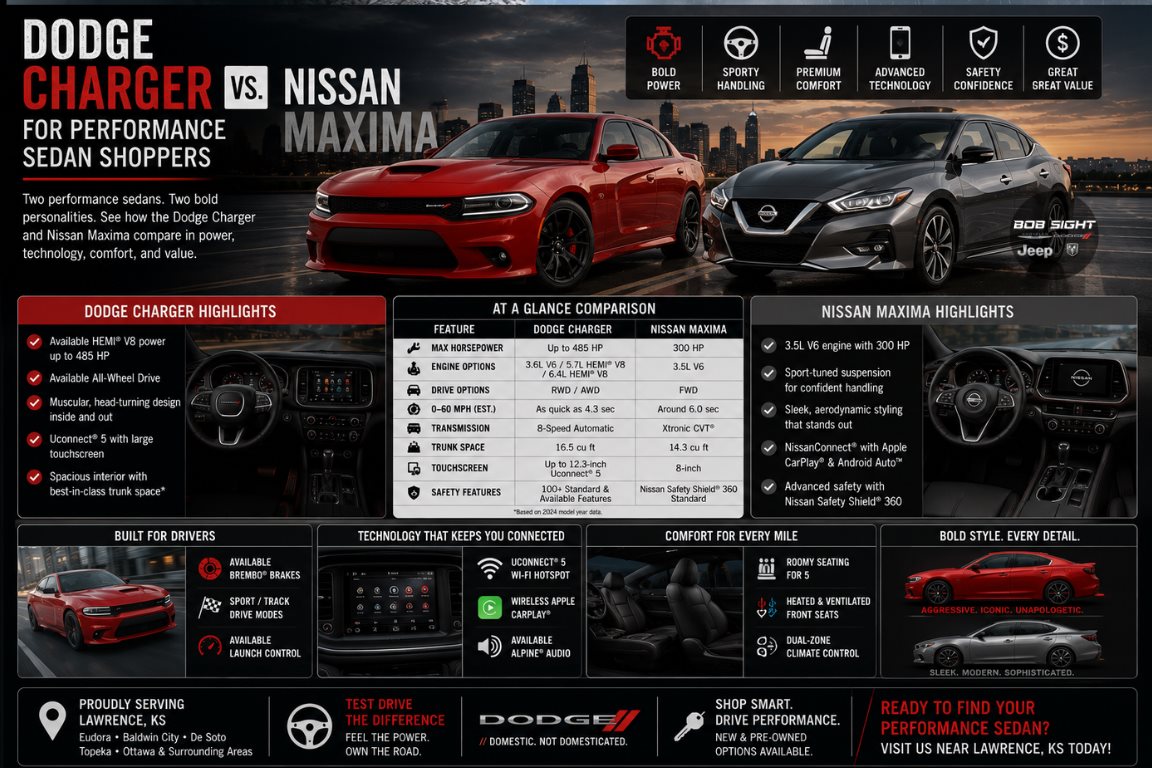
A side-by-side technical comparison clearly demonstrates the superior engine choices, horsepower ratings, drivetrain options, and trunk volume of the Dodge Charger over the Nissan Maxima. While both sedans represent popular choices in the full-size car market, their performance specifications reflect fundamentally different capabilities. The table below outlines key factory specs to help performance shoppers evaluate both models objectively:
| Specification / Feature | Dodge Charger (SXT / R/T / Scat Pack) | Nissan Maxima (All Trims) |
|---|---|---|
| Base Engine Architecture | 3.6L Pentastar V6 (292-300 HP) | 3.5L V6 Engine (300 HP) |
| Available V8 Engine Muscle | 5.7L HEMI V8 (370 HP) or 6.4L V8 (485 HP) | Not Available |
| Maximum Horsepower Output | 807 HP (SRT Hellcat Redeye) | 300 HP |
| Transmission Architecture | TorqueFlite 8-Speed Automatic | Xtronic Continuously Variable (CVT) |
| Drivetrain Layout Options | Rear-Wheel Drive (RWD) or Performance AWD | Front-Wheel Drive (FWD) Only |
| 0 to 60 MPH Acceleration | 3.8 Seconds (Scat Pack) / 3.6 Seconds (Hellcat) | 5.7 Seconds |
| Passenger Cabin Volume | 105.0 cu ft | 98.5 cu ft |
| Rear Trunk Cargo Volume | 16.5 cu ft | 14.3 cu ft |
For drivers who demand authentic muscle performance, iconic exhaust rumble, and the thrill of rear-wheel drive or performance AWD, the Dodge Charger stands in a class of its own. The Nissan Maxima offers sleek commuting style, but simply cannot match the raw horsepower choices, transmission refinement, or cabin space offered by the Charger.
Quick Facts: Dodge Charger vs Nissan Maxima Performance Highlights
Here is a quick reference summary of essential comparative facts and performance highlights between the Dodge Charger and Nissan Maxima:
- V8 Horsepower Dominance: Charger offers 370-hp 5.7L V8, 485-hp 6.4L V8, and 807-hp Supercharged V8 options, whereas Maxima caps performance at 300 hp.
- Authentic Performance Drivetrain: Charger features balanced RWD or available active Performance AWD, while Maxima is restricted to front-wheel drive.
- Transmission Refinement: TorqueFlite 8-speed automatic with paddle shifters delivers instant, mechanical gear shifts, avoiding CVT engine drone.
- Telemetry Tracking: Dodge Performance Pages app displays real-time 0-60 timers, G-force meters, and engine dyno readouts directly on the touchscreen.
- Full-Size Cabin Space: Charger provides 105 cubic feet of passenger room and 16.5 cubic feet of trunk capacity, easily beating Maxima interior dimensions.
- All-Weather Confidence: Available active AWD with front-axle disconnect provides incredible winter traction across Kansas highway snow squalls.
These key capability facts demonstrate why performance enthusiasts across the Kansas City metro continue to choose the Dodge Charger as their ultimate four-door car. It combines practical daily utility with muscle car soul that makes every drive exciting.
Ownership Planning for Long-Term Value and Midwest Driving
Long-term performance ownership satisfaction depends on choosing a vehicle platform that adapts to changing family needs, harsh Midwest winter weather, and long-distance highway commuting. When purchasing a new or certified pre-owned Dodge Charger at Bob Sight CDJR, evaluating how your vehicle will be used over five to ten years ensures you select the correct trim level, axle ratios, and options package upfront. Drivers who plan to commute year-round through winter snowstorms in Lawrence and Topeka benefit greatly from selecting models equipped with performance AWD and factory cold weather packages.
Midwest climate patterns in Douglas, Shawnee, and Johnson counties subject performance vehicles to rapid seasonal temperature changes, intense summer humidity, and corrosive road salt along I-70 and K-10. Protect your vehicle investment by opting for factory paint protection, all-weather floor liners, and scheduling regular underbody washdowns throughout winter thaws. Washing road salt from alloy wheels and suspension mounts prevents surface corrosion and helps maintain high trade-in and resale value down the road.
Partnering with an authorized local dealership for routine scheduled maintenance ensures your performance sedan receives genuine Mopar fluids, OEM brake components, and specialized diagnostic software updates. Keeping complete service records at Bob Sight CDJR enhances long-term mechanical reliability and builds documented provenance that future performance buyers value highly. Thoughtful ownership planning transforms your muscle sedan purchase into a reliable, thrilling asset for hundreds of thousands of miles.
Frequently Asked Questions About Dodge Charger vs Nissan Maxima
Is the Dodge Charger faster than the Nissan Maxima?
Yes, Dodge Charger V8 models are significantly faster than the Nissan Maxima, with the Charger Scat Pack achieving 0 to 60 mph in just 3.8 seconds compared to the Maxima 5.7 seconds. Even when comparing base V6 models, the Dodge Charger equipped with its 8-speed automatic transmission delivers quicker off-the-line throttle response and faster highway downshifts than the CVT-equipped Maxima.
For ultimate acceleration, the Dodge Charger SRT Hellcat reaches 0 to 60 mph in a breathtaking 3.6 seconds and achieves a top speed of 203 mph, placing it among the fastest production four-door sedans in the world. The Nissan Maxima offers no high-performance engine options to compete with HEMI V8 acceleration.
Experience the exhilarating acceleration and exhaust note of a V6 or HEMI V8 Dodge Charger by scheduling a test drive at Bob Sight CDJR in Lawrence. Our team can demonstrate launch control features in person.
How does the Dodge Charger handle Kansas winter weather compared to the Maxima?
The Dodge Charger equipped with available performance All-Wheel Drive (AWD) provides superior winter traction and stability compared to the front-wheel-drive-only Nissan Maxima. The Charger AWD system features an active transfer case and front-axle disconnect that continuously monitors wheel speed and outdoor temperatures. When temperatures drop below 40 degrees Fahrenheit or wheel slip is detected, the system automatically engages all-wheel drive to distribute torque smoothly across all four wheels.
While the front-wheel-drive Nissan Maxima offers basic traction control, it lacks all-wheel drive entirely. On snow-covered inclines or icy highway overpasses along I-70 near Topeka, the Charger AWD system provides far greater pulling power and directional stability. Paired with high-quality all-season or winter tires, an AWD Charger easily tackles severe Midwest winter storms.
Stop by Bob Sight CDJR on 23rd Street in Lawrence to explore our wide inventory of all-wheel-drive Dodge Charger sedans factory-equipped for winter commuting.
Is the Dodge Charger comfortable enough for daily commuting and family road trips?
Yes, the Dodge Charger is an exceptionally comfortable daily driver and family road trip car thanks to its spacious 105 cubic feet passenger cabin, supportive performance seats, and smooth highway ride. Unlike cramped two-door sports cars, the four-door Charger provides generous rear legroom and headroom, allowing adult passengers and growing teenagers to ride comfortably on long trips across Kansas.
Standard acoustic windshield glass, active noise cancellation technology, and refined independent rear suspension keep wind and tire noise low at 70 mph along K-10 highway. Available features like dual-zone automatic climate control, heated and ventilated front seats, a heated steering wheel, and an 8.4-inch Uconnect touchscreen ensure that every daily commute past the KU campus or long road trip toward Kansas City is relaxed and enjoyable.
Visit Bob Sight CDJR in Lawrence to test the interior cabin space, seating comfort, and trunk utility of the Dodge Charger with your family firsthand.
What is Dodge Performance Pages and does the Nissan Maxima have something similar?
Dodge Performance Pages is an integrated telemetry tracking app built into the Uconnect display that provides real-world performance readouts, timer logs, and launch control adjustments; the Nissan Maxima offers no similar feature. Performance Pages allows drivers to view digital gauges showing oil pressure, coolant temp, intake air temp, transmission fluid temp, horsepower and torque output curves, G-force meters, and 0-60 mph acceleration timers.
Drivers can also customize launch control RPM thresholds, shift light activation points, and adjust steering wheel resistance modes directly on the central touchscreen display. The Nissan Maxima includes a basic driver information screen on the instrument cluster, but lacks dedicated performance telemetry, acceleration logging, or launch control customization.
Test out Dodge Performance Pages in person at Bob Sight CDJR in Lawrence. Our technical specialists can walk you through all performance tracking and screen features during your visit.
Why Choose Bob Sight CDJR for Your Dodge Charger Performance Sedan
Bob Sight CDJR in Lawrence, Kansas, is your premier destination for the full lineup of new and pre-owned Dodge Charger models, backed by transparent pricing and dedicated customer service. Serving performance drivers across Lawrence, Topeka, Eudora, Baldwin City, and the greater Kansas City metro area, our dealership is committed to matching your driving passion with the ideal vehicle package. Conveniently located near Highway K-10 and US Route 59 on 23rd Street, our modern showroom showcases an extensive inventory of Dodge Charger SXT, GT, R/T, Scat Pack, and SRT Hellcat models.
Our commitment to your performance satisfaction continues long after you drive off our lot. Our certified CDJR service center is staffed by factory-trained technicians who specialize in HEMI V8 maintenance, performance braking service, wheel alignments, and sports suspension tuning. Utilizing genuine Mopar replacement parts, high-performance synthetic lubricants, and advanced diagnostic tools, we ensure your muscle car operates at peak output. We offer express service lanes, comfortable customer lounges, and easy online scheduling for your convenience.
When you are ready to experience the raw horsepower, iconic exhaust rumble, and full-size space of the Dodge Charger, visit Bob Sight CDJR in Lawrence. Browse our current new vehicle inventory online, schedule a personalized test drive, and discover competitive finance and lease options tailored to your budget.
Helpful Links
- Explore New Vehicle Inventory
- Schedule a Test Drive Online
- Value Your Trade-In Online
- Get Pre-Approved for Auto Financing
- Schedule Service at Bob Sight CDJR
Proud to Be Part of the Bob Sight Auto Group
Bob Sight CDJR is proud to serve Midwest drivers as an integral member of the trusted Bob Sight Auto Group family of dealerships. For generations, the Bob Sight Auto Group has maintained a reputation built on community support, honest business practices, and exceptional automotive care across Kansas and Missouri. Whether you need a powerful Dodge Charger muscle sedan, a versatile Jeep SUV, a reliable Honda sedan, a sleek Kia crossover, a tough Ford truck, or certified collision repair, our network of dealerships stands ready to serve you.